Friday, October 26, 2007

Fry Pan

I'm trying to think when it was that I first saw a frying pan referred to as a "fry pan." Because they are, you know, frying pans. "Fry pan" has an oddly unidiomatic sound to it, as if coined by a non-native speaker of English. Yet in recent years I often see these common kitchen items referred to as fry pans.

Then there's swimming suits, which are, you know, swimming suits. Only in recent years I often hear them called "swim suits." What in the world is a swim suit, and why should we call it a swim suit instead of a swimming suit?

The only comparison I can think of is the Superman costume I had when I was a kid. That was long before the days of idiot lawsuits, and yet the Superman costume had this idiot warning along the bottom hem of the shirt: "WARNING! This costume will not enable you to fly. Only Superman can fly."

Yeah, right, in 1965 I can hardly think of a kid so stupid, or a lawyer so avaricious, as to think that jumping off the roof of the shed in your Superman costume is going to lead to anything other than a nasty mishap. Of course nowadays the lawyers would be lining up to file a class action lawsuit on behalf of every kid who's ever even dreamed of wearing a Superman costume, "Hey, lawsuit this! The costume didn't have a warning label on it, so how were these kids supposed to know that the costume didn't enable them to fly?"

Result, a judgment for umpteen billion dollars against DC Comics, every costume manufacturer in the country, plus McDonald's, the tobacco companies, and the builder of that shed, all thrown in for good measure. From now on all costumes will come with 40 or 50 large warning tags attached, "Don't lawsuit us!"

Somehow in my paranoia I suspect there's a similar story behind the emergence of terms like "fry pan" and "swim suit." Somewhere in this benighted land there was a dim bulb who thought that a frying pan must naturally be a pan which will fry food placed in it, all on its own and unaided, with or without benefit of a functioning stove to supply heat. Or that a swimming suit will somehow enable you to swim and not sink, irregardless of whether you actually know how to swim or not.

On discovering that a frying pan sans stove will not fry food all by itself... on learning that a swimming suit of itself will not enable you to remain afloat if you don't know how to swim... the inevitable lawsuits were filed, and in due time won, with vast fines extracted from the hapless manufacturers of swimming suits and frying pans.

This led to a change in name. Now it's fry pan: "WARNING! This pan by itself, without a stove, will not fry food." And it's swim suit: "WARNING! This suit by itself will not enable you to swim. Only people who know how to swim can swim." And if you can't obey the warning label, and the lawyerly-altered new names of the products, hey, don't lawsuit us!

Look around and you'll find many examples of this bizarre and unidiomatic trend in renaming common, everyday items. It's no longer jogging suit, but jog suit: "WARNING! This suit will not enable you to run without effort, like some damn bionic exoskeleton. Some running effort required."

And now instead of ironing board, it's iron board: "WARNING! This board will not iron clothing by itself unattended. Human operator and clothes iron required, not included. Caution, iron can be HOT! Not to be used except under adult supervision, do not use while asleep."

And then there are paring knives, nowadays known as pare knives: "WARNING! This knife will not cut fruit, vegetables, or other items unaided. Requires a human user to make it cut things, CAUTION! Knife is sharp! Improper use can lead to serious injury or death!!!"

Google around, you'll find search results for carve knife, teethe ring, run shoes, and even roll pin. You know, instead of carving knife, teething ring, running shoes, and rolling pin. All in the interest of "Don't lawsuit us! These items will not perform, magically and unaided, without a human operator!" Yes, whoever heard of it? Oh, the emotional trauma! Include a warning label! These shoes will not make you run without effort on your part to put one foot in front of the other.

Labels:

Monday, October 01, 2007

Ethnic Mix

Like many an American, I'm something of an ethnic mix. A mongrel, a mutt, if you will.

I'm a quarter Norwegian and a quarter German, that's the easy part of it. The other half is an indeterminate mix of English and Welsh, with a sliver of Scottish thrown in.

On census forms I enter myself as "English-Welsh." I guess the Welsh part of it is what I really identify with. What, you don't pick up on the Celtic aspect of me from this blog? Mad Welshman, and all that?

Though it all tends to boil down, over the course of a couple of generations, into one big Mulligan stew. My Great-grandma spoke German fluently, she spoke English with a German accent. My Grandma could understand German just fine, and speak it okay if she put her mind to it. My Dad picked up some words and phrases in German. Me, I was totally innocent of the German language until I took a German reading course somewhere along the line in my academic studies: reading, no idea how to speak or pronounce it, and of course 20 years later it's all fled my mind.

On the other side of the family, at age 102½ my Grandma is still fluent in Norwegian. She was born in this country, but didn't learn English until she started school.

The usual pattern is, culturally assimilated no later than the third generation. I've sometimes wondered what I would've done if I'd been born into some small ethnic group in this country with its own language, you know, Navajo, Louisiana Cajun, or whatever. Somehow I suspect I would've zeroed in on the language and other aspects of the culture, immersed myself in it, and carried it on yet another generation. A generation further than usual, even.

Judging by that language of my own which I actually did concoct, I think that supposition is not too far fetched.

Labels:

Friday, September 07, 2007

Pronounciation

I heard a radio announcer the other day pronounce "mature" as "matchurrr." This is one that's always puzzled me, I'm sure there's a history behind it somewhere, but I've always pronounced it as "matoor."

Arrrghhh! Gargle, gargle! Match'rrrrrrrrr! Oh, it's not very matchurrrrr of me to make fun of people for saying matchurrr!

Labels:

Thursday, July 05, 2007

Pronounciations

They used to tell us to say creek, but we always said crick. I hear some people say off-ten; we never said anything but offen. I mean, that's like saying cass-tel for cassel!

Seems I hear a lot of people say melk for milk. And some even say chohldren for children.

And then there are the people (somehow I always think of them as being from Texas) who say heeeee-row for here-oh, and veeeee-hickel for vee'ick'l.

And I recently heard someone say see-antsy for seance.

And let's not get into grammar. How do you explain to a Frenchman, earnest student of English fresh off the jetliner from Paris, that out here in the heartland, it's not we haven't been going, but rather we ain't been goin'.

And please note, out here "been" is pronounced "ben," and neither "bean" (either British or else hoity-toity) nor (never heard it except in a grammar book) "bin."

Labels:

Tuesday, January 16, 2007

Snuck

I'm a great fan of colloquial, non-schoolmarm English. You know, "ain't," "warsh," "chimbley," stuff like that. It sort of makes up, in a small way, for English being not quite as loaded in weirdly divergent dialects as, say, Italian.

And I'm also a fan of irregular forms such as "ox, oxen," or "throw, threw, thrown." Not only are they cool, but there are philosophical depths which rise to expression in such irregularities; or am I the only person here who's read Ernst Cassirer?

But could someone please tell me what's up with "snuck" as a colloquial, irregular past tense of "sneak"? I mean, I think it's cool, I use it myself; but what's with it? Where did such a funky irregularity come from, anyhow?

Labels:

Friday, January 12, 2007

Alphabetizing Þ

Once upon a time the English alphabet made use of a non-Roman character called thorn (capital Þ small þ) for "th." You can see remnants of it today in the archaic "ye" for "the." There are still languages today, such as Icelandic, which use the letter þorn.

Ran across a cool page out there which presents exhaustive (and exhausting) arguments for the proper way to alphabetize words which include þ. Lots of charts of ancient alphabets, tabulation of various ways thorn is alphabetized today and has been alphabetized down through the centuries, all leading to the conclusion (presented almost in the spirit of a mathematical proof) that the proper thing to do with Þorn is to treat it as a letter following Z.

"7.0 Afterword. On Þornsday, 1994-06-09, CEN/TC304 resolved that in a default multilingual European sort, ÞORN shall be sorted as a separate letter after Z. Subsequently, ISO/TC37/SC2/WG3 resolved that in its work on alphabetical ordering, ÞORN shall be sorted as a separate letter after Z. Most recently, JTC1/SC22/WG20 resolved that in its work of producing a default multilingual sort for ISO/IEC 10646, ÞORN shall be sorted as a separate letter after Z."

Fascinating site, to those such as myself who are interested in languages and writing systems. I notice the front page is written in English and Irish Gaelic. Article on "The Alphabets of Europe." "Analysis of Olmec Hieroglyphs." Info on Eachtraí Eilíse i dTír na nIontas, alias Alice's Adventures in Wonderland in Irish; The New Testament in Cornish; The Hobbit in Irish, forthcoming; A Breton Grammar; and all other sorts of cool things.

Labels:

Thursday, September 07, 2006

Automatic Sayings Generator

Never tell all that you know; for he who tells all that he knows, often tells more than he knows.

Never spend all that you earn; for he who spends all that he earns, often spends more than he earns.

Never guarantee all that you undertake; for he who guarantees all that he undertakes, often guarantees more than he undertakes.

Never discuss all that you hear; for he who discusses all that he hears, often discusses more than he hears.

Never eat all that you can; for he who eats all that he can, often eats more than he can.

Ran across this one once upon a time in an old puzzle booklet from the 1930s. A long, long list of sayings like these, and more, all constructed on the same pattern: Never x all that you y... Odd, they all more or less made sense: it was a funny sort of "sense," a fortune-cookie sense; but I got the impression that it could have been extended indefinitely.

Labels:

Wednesday, May 31, 2006

English Translate

On the last 31st of a month— the 31st of March— I made a cryptic post, cryptic in that it was written in my own language, Hermetic. This being the 31st subsequent— the 31st of May— I thought I'd provide an English translation.

First, the original Hermetic:

------

Mna Chothracatho Yothov Chalol


Ridapavlimor yol "Icchizrogis Mna Gaiirico" im ir (Anghliig: "Let the Finder Beware") somiamisor omsipris mna chothracathot dhnampath cvadro ghji pantho spdhaji jondirr-saptho... Dhalmthinol Thalsthilamthino i, omzaníghj Sitavisamthinor ghri Solmthinor. Sfago sghwaoro ghty'omcamanis, mna chothracathoth somiamisor cai omchochilaris. Cai vorthor somchothracisor omsovis omFananthig.

Yothov chalol voist, cai thlichasos mna chali.

Ghty'ompsaris.
------

And now, the English translation:

------

A Post About Nothing


I try to set down some kind of post for my weblog "Let the Finder Beware" (English: "Let the Finder Beware") four or five days a week... from Monday through Friday, less often on Saturday or Sunday. But early this morning I got up, and didn't have any post ready to write. So I decided to post in Hermetic.

It's a post about nothing, and nobody will be able to understand it.

I'm just saying.
------

Don't you wish that you had a language of your own? :-)

Labels:

Friday, March 31, 2006

Mna Chothracatho Yothov Chalol

Ridapavlimor yol "Icchizrogis Mna Gaiirico" im ir (Anghliig: "Let the Finder Beware") somiamisor omsipris mna chothracathot dhnampath cvadro ghji pantho spdhaji jondirr-saptho... Dhalmthinol Thalsthilamthino i, omzaníghj Sitavisamthinor ghri Solmthinor. Sfago sghwaoro ghty'omcamanis, mna chothracathoth somiamisor cai omchochilaris. Cai vorthor somchothracisor omsovis omFananthig.

Yothov chalol voist, cai thlichasos mna chali.

Ghty'ompsaris.

Labels:

Sunday, February 12, 2006

Irregular Plurals

I've always thought irregular grammatical forms were really cool. There's something that shines through them, something aesthetic that refuses to be shoehorned into the pattern. There are (if I recall correctly) almost 200 irregular verbs in English, such as rise, rose, risen; or sink, sank, sunk.

Not near as many irregular plurals in English, though I've always appreciated those we have. Man, men; woman, women; child, children; ox, oxen; foot, feet; tooth, teeth; goose, geese; mouse, mice. Am I missing any?

There are also some words which are the same in both singular and plural: sheep, deer, fish; and I've seen usage which extends that practice to many animal names. I've also seen cannon used as a plural, as if a cannon were somehow wild game to be hunted.

There are some classes of nouns which end in an unvoiced consonant in the singular, and in the corresponding voiced consonant in the plural. Leaf, leaves; elf, elves, etc. Not all plurals of this sort are indicated in writing, and so if you're like me, they may not always occur to you: house, houses, where houses is pronounced like houzzes; or bath, baths where bath is pronounced with th as in thin, but baths is pronounced with th as in that.

And then there are the "imported" irregular plurals, many of them from Latin or Greek: radius, radii; spectrum, spectra; phenomenon, phenomena; criterion, criteria; antenna, antennae. I've got to confess, antennae doesn't sound right to me, and it seems I usually hear it on science shows for kids, where it's pronounced with artificial emphasis, as if to get it across to the kids that here's a word you'd better learn. Though even on those science shows, I don't know that they display any uniformity of pronunciation, as I seem to hear sometimes antennay, sometimes antenneye, and sometimes antennee. Much as I love irregular plurals, I tend to split the difference on this one by pronouncing it antennas.

Labels:

Saturday, December 31, 2005

Can You Raed Tihs?

Olny srmat poelpe can raed tihs. Cdnuolt blveiee taht I cluod aulaclty uesdnatnrd waht I was rdanieg. The phaonmneal pweor of the hmuan mnid, aoccdrnig to rscheearch at Cmabrigde Uinervtisy, it deosn't mttaer in waht oredr the ltteers in a wrod are, the olny iprmoatnt tihng is taht the frist and lsat ltteer be in the rghit pclae. The rset can be a taotl mses and you can sitll raed it wouthit a porbelm. Tihs is bcuseae the huamn mnid deos not raed ervey lteter by istlef, but the wrod as a wlohe.

Amzanig huh? yaeh and I awlyas tghuhot slpeling was ipmorantt!

(h/t Chelsey)

Labels:

Thursday, December 29, 2005

Favorite Words

Occidental

Incarnadine

Aerial

These are just a few of my favorite words.

Labels:

Monday, November 21, 2005

Aunt

So is "aunt" pronounced ant, or awnt, or ahnt? I say ant. Though you may say tomahto. ;-)

Ant, Awnt, Ahnt. Is there any other word in English which has three common and accepted pronunciations?

In fact, there may be a fourth pronunciation of "aunt": I seem to recall, on the old Andy Griffith show of my childhood, Aunt Bea being called "Ain't Bee."

Labels:

Wednesday, October 19, 2005

Mumble

Yesterday I headed out to a nearby town to eat at Subway. Got there, ordered a foot-long Italian BMT, and the young lady working behind the counter asked me, "Kah'chiss?"

She asked me, "Kah'chiss?"

I said excuse me, and she repeated herself, this time more clearly: "What kind of cheese?"

Things went fine again until we got to the various veggie toppings. She asked me, "Works?" This I could decipher: she was asking me if I wanted the works. I said I'd have everything except onions and peppers.

She said, "N'urrrh?"

I had to ask her two or three times to repeat this before it became disambiguated as, "And cucumbers?" Oh, of course, silly me— "urrrh" is the obvious collapsed enunciation of "cucumbers"!

But they were almost out of cucumber slices, so she excused herself by saying, "Beh'minneh!"

Since she then disappeared somewhere into the back of the shop with the plastic dealie for cucumber slices, I took "Beh'minneh!" to mean, "Back in a minute!"

Another gal behind the counter took advantage of this lull to ring me up at the cash register. Of course, with the requisite, "Would you like to get the meal with that?" and "Would you like to super-size your soft drink with that for an additional twenty cents?" Already knowing a free way to supersize a drink— just don't use as much ice— I declined that one.

Now the mumbler returned from out back, with a plastic dealie full of cucumber slices. She asked me, "Sauce?"

I asked for mustard, and she said, "Spicy'en?"

I couldn't figure this one out, so I got her to repeat it a couple of times until it became clear that this was her abbreviation for "Spicy or honey mustard?" Ah, I see, name one of the alternatives and leave the customer to infer the rest...

So I said spicy mustard. And she then asked me, "Cherryin' oop?"

You heard that right: "Cherryin' oop?"

I had to ask her to repeat this at least twice before I realized she was asking me, "Did she already ring you up?"

Oh, right. I mean, "Cherryin' oop?" is the obvious and natural compression of "Did she already ring you up?" You know, "Did she already ring you up?"

We were now entering the territory of lossy data compression.

I fled to a table, and sat there eating my sandwich as I listened to puzzled customers in line bombarding this gal with, "What? What? What?"

I can testify that she was a native speaker of English, she had no speech defect, and she seemed to be somewhere within the normal range of intelligence. I think she had simply gotten into such a rut in her work, repeating the same phrases over and over again all day long, that these phrases had somehow worn down into half-hearted attempts at a vocalization, never use six syllables when you can squeak by with one.

Only thing that really worries me is whether this represents a trend among young people. I mean, I've gotten used to upspeak. I've adjusted gradually to tattoos and body piercing. I've adjusted even to those colored gummy-rubber bracelets which I've seen worn by otherwise grown twenty-somethings. But if we are now entering into an era of LZW speech compression, or the spoken equivalent of the chat room's "thk u ppl 4 ur help l8r peace out"...

Labels:

Tuesday, September 27, 2005

Ain't

I once utterly infuriated my fifth-grade teacher.

I've always been a great defender of the word "ain't," which after all has a long history in English, going back several hundred years. Anyhow, my teacher was insistent that "ain't" was not a "real" word. I asked, "Why not?"

She said, "Because it's not a contraction of anything. What is 'ain't' a contraction of— 'ai not'?"

I said, "Well, but 'won't' is good English, isn't it?"

She had to concede that it is.

I then had the impertinence to reply, "So then what is 'won't' a contraction of— 'wo not'?"

Back in those long-ago days, this was known as "getting sassy with the teacher." Otherwise known as "asking inconvenient questions."

And let's not get into double negatives, which have a history in English going back a good thousand years, to the days of Anglo-Saxon...

Labels:

Tuesday, July 26, 2005

Hey Santa!

Odd but true fact: my brother and I often call each other "Santa."

I recall reading that the novelist Walker Percy and a friend of his used to call each other "Rollo"; apart from that, I've never heard of two people calling each other by the same nickname.

Origin of the practice: back when I was a twenty-something, we went to a theater in Madison, and it must've been shortly before Christmas, because there was a commercial before the movie where these elves were saying to Santa Claus, "Hey Santa, want a Coke?" Somehow we twisted this to, "Hey Santa, want some Jonestown punch?" And from there to calling each other "Santa."

Labels:

Wednesday, June 15, 2005

Don't Loose You Head!

Time was, nobody saw as many dead bodies as a reporter on the crime beat, and nobody saw as many misspelled words as an English teacher. But nowadays, thanks to the Internet, anyone can get to read just as many misspellings and mangled usages as any English teacher.

For instance, before I got on the Internet, I don't believe I had ever in my life seen the word lose misspelled as loose: "We knew we were going to loose the game."

I just don't get it. I mean, to my eye, loose doesn't look like "looze." It doesn't even remotely look like "looze"; it looks like "looss," and to me it could never look like anything but "looss."

Then there's the use of you as a possessive— that is, you in place of your: "What is you name?" Or "Don't loose you head!"

Once again, I simply do not get it. Many a time down through the years, I've encountered written confusion between your and you're. But never in my life out here in meatspace— indeed, never in my life until I got on the Internet— had I ever seen you used in place of your.

There are many of these Common Internet Misspellings— misspellings that I see often on the Internet, but seldom if ever saw back in the pre-WWW era.

For instance, definately is a Common Internet Misspelling (CIM) for definitely.

And formally known as is a CIM for formerly known as.

Just as midas well is a CIM for might as well.

Just as doggy-dog world is a CIM for dog-eat-dog world.

And just as choldren, childern, and even choldern are CIMs for children. (Though I do sometimes hear people pronounce children as "chohldren." Just as I often hear people say "melk" for milk.)

I tend to be "usage first" when it comes to matters of grammar— note, "usage first," not "usage, the only arbiter"— you know, ain't, split infinitives, that sort of thing. But on matters of spelling, I tend to be much more sticky. I think it's no coincidence that just in recent years— just since the Internet became popular— I've begun to run across "Internet-like" misspellings frequently— not just once in a while, but frequently— not only on websites, but also on product labels and on professionally printed, publicly posted signs.

And whether on a website or in everyday life, I do draw the line at the likes of "southmore" for sophomore, and (no, I'm not making this one up) "southball" for softball.

Labels:

Friday, June 10, 2005

A Language of My Own

When I was 13 years old, in eighth grade, I started constructing my own language. We're not talking a short word list or a few limited pieces of jargon, we're talking an entire functioning language. With its own grammar, its own vocabulary, its own idioms, and its own meanings which are often hard to translate into English. I kept on working on this language for years. I'm still working on it today, 35 years later.

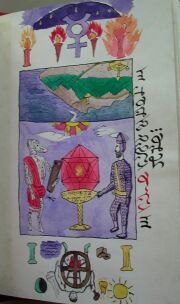
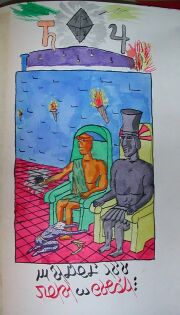
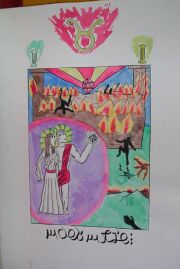
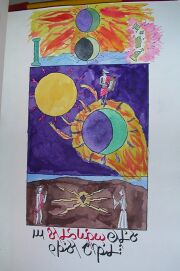
Mna Vanant Fnidis Dhalathlo mna Sthiloth
The language— which is called Hermetic, or in Hermetic itself, mna Vanantha— rapidly took on a life of its own. I'd heard of "international" languages like Esperanto or Volapük, but those first few years I was working on my own language, as far as I knew I was the only person in the world who had ever constructed his own language for no practical reason at all, just out of sheer love of the language itself as it emerged and grew.

Then when I was a sophomore or junior in high school, my English teacher tipped me off about Tolkien and Lord of the Rings. I immediately recognized a kindred spirit in Tolkien: he was the first person I ever heard of who had done with constructed languages what I was doing with them. Though by then, Hermetic was too far along to be influenced by Tolkien.

The Hermetic noun has three numbers: singular, dual, and plural. Ten noun cases: nominative, accusative, equative, genitive, dative, illative, locative, instrumental, interrogative, and vocative. The Hermetic verb has two persons, two modes, three tenses, eight moods, and five aspects, to say nothing of specially inflected forms for use in subordinate clauses.

Mna Dhalathlw'Adis Sitavisa cai Tistrya
Ai, gaimoz it dhalvanov mna pano vagov avnav icvaolis?! (English translate: "What the deuce is a person supposed to do with all this, anyway?!") Well, at age 17 I wrote a book in my language, entitled Mna Sipri Cilama ("The Celestial Labors"). By this time I was also working out the Hermetic people and their culture, and this book was the apocalyptic scripture of Hermetic Dualism, which is in some ways a take on gnosticism, although here it was the evil sun-god, Rotas, who was trying to free the world from multiplicity and return it to the undivided unity of the primordial point. While it was the good moon-god, Dhalbembu, who was struggling to preserve the "myriad-faceted jewel" of this tangled world in all its diversity. Think the Silmarillion, only worse.

Mna Cathis mna Sthiloth
To read and comprehend Mna Sipri Cilama in the original, you need to understand more than just Hermetic vocabulary and grammar. You need to fathom the nuances of Hermetic— the finely shaded inward "feel" of the language, of terms and idioms and concepts which defy translation. How can I convey the meaning of Hermetic terms such as dhnamo and athlo? Each denotes awesome power, and yet dhnamo is the power of lightning, of the sword stroke, of main and might. While athlo is the power of the unforeseen chess gambit, of architectural form, of perfect balance, of the craftsman's master touch. To the Hermetic mind, it is obvious that the sun is dhnama, while the moon is athla.

I was speaking, reading, writing, and thinking in a language of my own. You want to hear how Hermetic sounds? Here's an MP3 of me reading aloud from chapter 25 of Mna Sipri Cilama.

Mna Dhalbembu Thalis Pirisa Zvirol
Try to grasp how alien Hermetic is, not just outwardly but inwardly. Not only had I constructed a language of my own, but in a sense I had become a one-man folk. Here I was, 17 years old, living in a small town in southern Wisconsin, and spontaneously inhabiting a thought-world purner as alien and as remote as the culture of the ancient Maya.

Yet at the same time I remained a committed and quite traditional Presbyterian. Hey, no problem: by this time I was reading things like Tolkien's essay on "subcreation." I totally grokked what Tolkien was up to; because, from before I ever even heard of Tolkien, I'd been doing the same thing myself.

But like I say, I was inhabiting a world of my own. A world which was (and is) an important part of who I am. But a world which, by its nature, I was unable to share with anyone. That can be very lonely. In the late 1970s I was in correspondence, for a time, with a couple of people out there in "fandom" who had created their own languages. And down through the years, I heard odd rumors here and there. But until just over two years ago, I thought that we language-makers must be an exceedingly rare and almost unheard-of phenomenon.

Then I stumbled across the website of Sally Caves, an English professor who had begun creating her own language, Teonaht, when she was only nine years old. And through her site I found all sorts of other sites of people who had their own "constructed languages" or "conlangs." I thought to myself, Ai, gaimoz il yothov dhalvanof vagi ridalcary'avn'ist? ("What the deuce are all these websites about, anyway?") I contacted Sally, and she introduced me to the conlang community out there on the Internet.

Turns out that constructing a language of your own is uncommon, but hardly unheard of. There are hundreds of us out there. Some people nowadays do it because of Tolkien, or because they heard of "conlanging" and wanted to try it out for themselves. But there are a good number of us conlangers— like Sally Caves or myself— who simply started making up a language of our own spontaneously, often in childhood, for no practical reason, in endless detail, and with no idea that anyone else before us had ever blazed this trail. It's like being driven. It becomes an obsession. It's almost like glossolalia on a slow burn.

The other day I turned on the radio, and the AM stations were drowned out by the loud crashing static of summer thunderstorms. The first thought that came into my mind— I kid you not— was, O chimo pronthisol cijal! Rough English translate: "Listen to the echo of distant thundering!"

Labels: , ,

Wednesday, June 08, 2005

Chunk It!

I once knew this fellow whose name was Chuck. And he refused to take his own name in vain.

Where you and I would say, "Chuck it!"... Chuck would instead say "Chunk it!" He would not say "Chuck it!", because "chuck" wasn't just any old word, "Chuck" was his name.

He wasn't demonstrative about it, he never explained himself, and you might know him a long time before you ever caught onto this little quirk of his. Then, in conversation, it would just quietly slip out. He simply could not or would not use the word "chuck" as a verb or common noun. He always said "chunk" instead.

I didn't know quite what to make of this. I mean, I had known since early childhood that the word pall (as in funeral pall, or as in A gloomy pall hung over the crowd) was a homonym for my first name. And growing up on Sam Loyd rebuses in The Human Interest Library, I was well aware that P + [Picture of an Awl] was a rebus for my name— I think I identified with this one more than anything else.

As I grew older, I became aware that another homonym of my name was pawl, "a lever which engages with a ratchet wheel so as to permit movement in one direction only."

Hell, I even ran across one wag who contrasted Norman Vincent Peale with my sainted namesake from Tarsus, thus: "Paul appealed, but Peale appalls."

And through all of this, I never had the slightest trouble using the words "pall," or "pawl," or "awl," or even "appall," simply because my name is Paul.

So what was it with Chuck, and "chunk it!"? Have you ever known any folks who had a hard time using words that sounded like their own name?

Labels:

Wednesday, June 01, 2005

Lunch at 9:00 PM, and Bubblers

When I first moved to this corner of Iowa, I was blown away to discover that when people around here say "lunch," they mean a snack or light meal served at any hour of the day. Yes, in these parts you can eat lunch at 10:00 in the morning, or at 3:00 in the afternoon, or even at 9:00 in the evening.

This just blew me away. I mean, where I came from in southern Wisconsin, "lunch" was always the noon meal, eaten more or less during the noon hour. You know, three meals a day, breakfast, lunch, and supper? Or (slight variability here) some people might say breakfast, lunch, and dinner. Or even breakfast, dinner, and supper. There was some wiggle room there, from one person to the next, on the meaning of the word "dinner."

But "lunch" was always the midday meal.

Until I came here to Iowa, and found that "lunch" was not tethered to any specific time of day. Is it just Iowa? Or is this use of the word "lunch" more widespread?

I mean, I know where I grew up over in Wisconsin, what you'd call a "drinking fountain," we always called a "bubbler." You know, get a drink of water from the bubbler? But over here in Iowa, when I call a drinking fountain a "bubbler," people look at me like I'm demented.

"Lunch." "Bubbler." I'd love to see a geographic atlas for the use of such words.

Labels:

Saturday, January 29, 2005

And the Name of This Supper Club Is...

The other day, I was driving by a place where I occasionally eat. And I noticed there were two signs on the building. One read, "So-and-So's Dugout." And the other one read, "So-and-So's Supper Club."

And I thought to myself, so which is it? Dugout or Supper Club?

Actually, this is a phenomenon of the small-town Midwest which I've noticed for years. Often a supper club, bar, tavern, restaurant will not have a single consistent name. You'll see various signs posted on or around the establishment, and often these signs won't carry the same name.

That supper club down on the highway by the edge of town, with two signs on it... one sign reads Doc "n" Jo's. The other sign says The Blue Pheasant.

Or, more puzzling yet, one sign says The Blue Pheasant, while the other reads The Golden Pheasant.

So which is it? Blue or Golden?

Or then there's the restaurant which is styled on one sign as the Dew Drop Inn, and on the other sign as The West Side Cafe.

I even know of one eating place on a winding, twisting road over in western Wisconsin, that has two names on the same sign. In big letters above, it says The Hawk's Nest. On a little placard hanging right underneath it reads Whipoorwill.

Don't look for a reason. Don't look for an explanation. This is simply one of the enigmas of life in a small town.

Labels:

Thursday, November 18, 2004

Anagram You

Have you ever tried to form anagrams by rearranging the letters in your name? Well, now it's easy, thanks to Wordsmith.org's anagram server.

Some years back, I was idly struck with this cool idea: what if someone wrote a series of novels, with the title of each novel an anagram of the author's name? Let's see, "Paul Burgess"... Well, if I knew anything about music and musicians (which I don't) I might attempt a trilogy about the life and career of a bluegrass musician...

First volume would trace the musician's rise from humble beginnings... it could be titled (anagram of "Paul Burgess") Bluegrass Up.

Second volume would follow his meteoric flight through the stratosphere of fame... title (anagram of "Paul Burgess"), Pegasus Blur.

And the third volume would chronicle the musician's messy affair with a barmaid, and his ensuing sad decline and fall. It would have the Clintonian title of (anagram of "Paul Burgess") Pub Lass Urge.

Try it out. Anagram yourself. Anagram your friends. Anagram your enemies. Do you have any novels, or trilogies, in you?

(Tip of the hat to Blackboar)

Labels:

Wednesday, November 17, 2004

Strangely Apt Misreadings

Do you ever find yourself misreading a sign, purely by accident? Yesterday on the way back from La Crosse I stopped off at a Kwik Trip for gas. And here's how, at first glance, I read the sign on the gas pump:
WARNING— It is unnatural and dangerous to dispense gasoline into disapproved containers.

Of course, on second glance, actually that read:
WARNING— It is illegal and dangerous to dispense gasoline into unapproved containers.

I like my misreading better. The novelist Walker Percy wrote an interesting essay on "metaphor as mistake." Someone mistold him that a certain bird was a "blue-dollar hawk." Percy was disappointed when he learned the bird was actually called a "blue-darter hawk": "blue-dollar" seemed so much more apt than "blue-darter."

In one of his better-known poems, Dylan Thomas wrote:
Altarwise by owl-light in the half-way house
The gentleman lay graveward with his furies;
Abaddon in the hangnail cracked from Adam,
And, from his fork, a dog among the fairies,
The atlas-eater with a jaw for news,
Bit out the mandrake with to-morrow's scream.

But what was Thomas saying? A poet has to hit the bullseye only a handful of times in his career, to be considered a great poet. But what sort of bullseye is it, that is characterized by what we would ordinarily call missing the target altogether? There is a certain kind of poetry (some people don't care for it, but I'm not one of them) which works, and succeeds, by trafficking heavily in "metaphor as mistake." What in the world is going on here?

Meanwhile, remember, It is unnatural and dangerous to dispense gasoline into disapproved containers.

Labels: