Wednesday, September 05, 2007

Jack Kerouac and On the Road

Fifty years ago today Jack Kerouac's novel, On the Road, was published. A tale of the frantic cross-continent travels of narrator Sal Paradise and his friend Dean Moriarty, seeking in search of they knew not what, only the rhythm and the pace of life accelerated until they were sprung clear out of any bourgeois frame of reference: "Yes! Yes! We know time!" The tale was autobiographical, an only thinly disguised telling of the journeys of Kerouac himself and his friend Neal Cassady.

They were part of what was known as the Beat Generation, along with other writers such as Allen Ginsberg and William S. Burroughs. But Kerouac was the greatest writer of all the Beats. He developed a writing style which was based in part on the pacing and the techniques of jazz music. He was trying to make language perform feats well beyond its rated capacity. And in a soaring, efflorescent, noneuclidean way, he did it.

To me, with my interest in signs and symbols, the what and the how and the why of Kerouac's success are of considerable import. But part of it is simply fascination with Kerouac's literary corpus— not only On the Road, but his other writings as well, The Dharma Bums and Desolation Angels and Big Sur and Tristessa and Old Angel Midnight and "October in the Railroad Earth" and so many more, oh, and the unfathomable brilliance of Visions of Cody.

I don't know why I didn't discover Jack Kerouac sooner. It wasn't until I was in my mid twenties that I ran across a paperback copy of On the Road, at Powell's Books in downtown Portland, Oregon. You know, that gigantic bookstore on West Burnside, across the street from what was then the Blitz-Weinhard brewery? This was 1983 or 1984.

I read the book, and I loved it. "Yes, yes, we know time!" Then it gathered dust on my shelf until I was in my mid 30s. This was when I began to collect and read everything I could find, by or about Jack Kerouac, Allen Ginsberg, William Burroughs, Neal Cassady, John Clellon Holmes, and the entire Beat Generation.

I've never been able to figure quite what it is about the Beats that so grips me. Like I say, part of it is Kerouac's luminescent noneuclidean jazz-inspired prose. But I think part of it has to do with mixed feelings I've always had about the Sixties.

It was during the cultural plate-tectonic shift known as the Sixties— really, the late 1960s on into the early 70s— that I came of age as an individual. Hey, beard, blue jeans, Beatles music, it shows? Without the experience of growing up in the Sixties, I can't imagine who I would be today.

The culture got some of the starch knocked out of it, and that was a good thing. Conformity slipped on a banana peel, and that was a good thing too. There was a genuine sense of spiritual questing. And on some deep level, something happened to the cultural sensorium. Any style or motif current in 1920 or 1950 was still available, in some key, in 1968 or 1998. Art deco? Formica tabletops? Egyptian hieroglyphics? No problem! While much of what flashed across the screen, post-Sixties, would have been unintelligible half a century earlier. Five surreal images per second? Fifty years ago, many TV commercials from the late 1990's would not even have been not understood— they would simply have frozen the brain in sensory gridlock. On a cultural level, on the simple level of images that flit through the mind's eye, the 60s did indeed open wide the doors of perception.

But the Sixties also gave rise to a festering sense of anger, self-righteousness, carefully nursed grievance, which was far from healthy. Rancor in the name of peace, vindictive intolerance in the name of tolerance— a bumper sticker I once saw sums it up: "Support mental health, or I'll kill you!" The nonconformity of the Sixties often struck me as a "nonconformity for the millions," mass produced, everybody different exactly alike, and woe betide the true individualist who differed not only from the conformists, but also from the nonconformists.

I think this is part of what I like about the Beat Generation. They really were different— not just from the mass culture, but from one another as well. They really were blazing their own trail— not just buying into some prefabricated and prepackaged "nonconformity" which was the same in New York and LA, in Pittsburgh and in Denver and in Urbana-Champaign.

"...I shambled after as I've been doing all my life after people who interest me, because the only people for me are the mad ones, the ones who are mad to live, mad to talk, mad to be saved, desirous of everything at the same time, the ones who never yawn or say a commonplace thing, but burn, burn, burn like fabulous yellow roman candles exploding like spiders across the stars and in the middle you see the blue centerlight pop and everybody goes 'Awww!'" —Jack Kerouac, On the Road. Published September 5, 1957.

Labels:

Saturday, July 07, 2007

Robert A. Heinlein, Born July 7, 1907

Robert A. Heinlein was born 100 years ago today, July 7, 1907, in Butler, Missouri. He was one of the greatest science fiction writers of all time, and even that may be an understatement.

I remember the first Heinlein book I ever read. It was Red Planet. I was in 7th grade, I had checked the book out of the school library, and despite the fact that I had a headache, I lay there all evening on the davenport, reading that book from cover to cover.

I eventually ended up reading almost all of Heinlein's writings, novels, short stories, essays. Well, not all of it: I Will Fear No Evil defeated my best intentions, and there were a few of Heinlein's later novels that I simply skipped. But I've read most of Heinlein: he fills 25 inches of shelf space in my science fiction bookcases.

My favorite Heinlein novel was Citizen of the Galaxy. Thorby, Baslim, the Free Traders: I cannot exaggerate the impact this book had on me, and I suspect I've read it a dozen times over.

Above and beyond that, other favorites would include Have Spacesuit, Will Travel; The Door into Summer; Starship Troopers; and (??!) Farnham's Freehold. These books, and others of Heinlein's, simply became part of my mental furniture. You sit down, you open the book, you read, you reread. When you come to, you find that the afternoon has fled. Heinlein had a way of drawing the reader into the book; I don't know, it's hard to put into words, it resists analysis.

But I've always thought that's the mark of a great writer: they resist easy analysis. I want to say Heinlein is one of my favorite science fiction authors because he knew how to write, and he knew how to tell a story; and that's probably close to the mark. But I think the truth is simpler and more basic than that: for whatever reason, I simply find myself drawn back to Heinlein's writings, again and again and again.

Later Heinlein I sometimes find tedious. But I did like The Number of the Beast. Ditto Friday, and the first half or so of The Cat Who Walks through Walls.

I read some people who tell how Heinlein had a major impact on their own philosophy and worldview. I have to confess that Heinlein's books have had little if any influence on my overall outlook. In fact, often as not I find myself in disagreement with him; though I usually find his thinking intriguing. But I seldom read fiction on the basis of whether I agree or disagree with the author's views.

I will never forget driving along through the countryside, one beautiful sunny day in May of 1988. I had just finished up my first year of graduate studies at Duke University, and somehow a lazy afternoon of drifting from one highway to the next had led me on up out of North Carolina, and into Virginia. My car radio was tuned to I don't know what station, and the news came on at the top of the hour. One of the news items was that science fiction writer Robert Heinlein had died.

Robert A. Heinlein. Born 100 years ago today, July 7, 1907. Died May 8, 1988. He was indeed the Dean of Science Fiction.

Labels:

Thursday, January 04, 2007

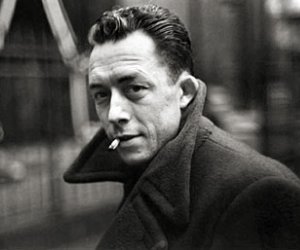
Albert Camus, Died January 4, 1960

Albert Camus
"The high seas. The sun sinks and is swallowed by the fog long before it reaches the horizon. For a brief moment, the sea is pink on one side and blue on the other. Then the waters grow darker. The schooner slides, minute, over the surface of a perfect circle of thick, tarnished metal. And, at the most peaceful hour, as evening comes, hundreds of porpoises emerge from the water, frolic around us for a moment, then flee to the horizon where there are no men. With them gone, silence and the anguish of primitive waters are what remain.

"A little later still, we meet an iceberg on the Tropic. Invisible, to be sure, after its long voyage in these warm waters, but still effective: it passes to starboard, where the rigging is briefly covered with a frosty dew, while to port the day dies without moisture.

"Night does not fall at sea. It rises, rather, toward the still pale sky, from the depths of waters an already drowned sun gradually darkens with its thick ashes. For a brief moment, Venus shines alone above the black waves. In the twinkling of an eye, stars swarm in the liquid night.

"The moon has risen. First it lights the water's surface gently, then climbs higher and inscribes itself in the supple water. At last, at its zenith, it lights a whole corridor of sea, a rich river of milk which, with the motion of the ship, streams down inexhaustibly toward us across the dark ocean. Here is the faithful night, the cool night I called for in the rollicking lights, the alcohol, the tumult of desire.

"We sail across spaces so vast they seem unending. Sun and moon rise and fall in turn, on the same thread of light and night. Days at sea, as similar each to the other as happiness...

"This life rebellious to forgetfulness, rebellious to memory, that Stevenson speaks of."

   —from his essay, "The Sea Close By"

Albert Camus, November 7, 1913 — January 4, 1960

Labels:

Saturday, November 25, 2006

Top Science Fiction/Fantasy Novels I've Read

(From Deb, at Dispatches from Blogblivion)

This is a list of the 50 most significant science fiction/fantasy novels, 1953-2002, according to the Science Fiction Book Club.

Bold the ones you've read, strike-out the ones you hated, italicize those you started but never finished and put an asterisk beside the ones you loved.

The Lord of the Rings, J.R.R. Tolkien *
The Foundation Trilogy, Isaac Asimov
Dune, Frank Herbert
Stranger in a Strange Land, Robert A. Heinlein
A Wizard of Earthsea, Ursula K. Le Guin
Neuromancer, William Gibson *
Childhood's End, Arthur C. Clarke
Do Androids Dream of Electric Sheep?, Philip K. Dick
The Mists of Avalon, Marion Zimmer Bradley
Fahrenheit 451, Ray Bradbury *
The Book of the New Sun, Gene Wolfe
A Canticle for Leibowitz, Walter M. Miller, Jr.
The Caves of Steel, Isaac Asimov
Children of the Atom, Wilmar Shiras
Cities in Flight, James Blish *
The Colour of Magic, Terry Pratchett
Dangerous Visions, edited by Harlan Ellison *
Deathbird Stories, Harlan Ellison
The Demolished Man, Alfred Bester
Dhalgren, Samuel R. Delany
Dragonflight, Anne McCaffrey
Ender's Game, Orson Scott Card
The First Chronicles of Thomas Covenant the Unbeliever, Stephen R. Donaldson
The Forever War, Joe Haldeman
Gateway, Frederik Pohl
Harry Potter and the Philosopher's Stone, J.K. Rowling
The Hitchhiker's Guide to the Galaxy, Douglas Adams
I Am Legend, Richard Matheson
Interview with the Vampire, Anne Rice
The Left Hand of Darkness, Ursula K. Le Guin
Little, Big, John Crowley
Lord of Light, Roger Zelazny
The Man in the High Castle, Philip K. Dick *
Mission of Gravity, Hal Clement
More Than Human, Theodore Sturgeon *
The Rediscovery of Man, Cordwainer Smith
On the Beach, Nevil Shute
Rendezvous with Rama, Arthur C. Clarke
Ringworld, Larry Niven *
Rogue Moon, Algis Budrys *
The Silmarillion, J.R.R. Tolkien
Slaughterhouse-5, Kurt Vonnegut
Snow Crash, Neal Stephenson
Stand on Zanzibar, John Brunner *
The Stars My Destination, Alfred Bester *
Starship Troopers, Robert A. Heinlein *
Stormbringer, Michael Moorcock
The Sword of Shannara, Terry Brooks
Timescape, Gregory Benford
To Your Scattered Bodies Go, Philip Jose Farmer

As you'll notice, most of the science fiction and fantasy I've read was published before 1975, or is by authors who became established before 1975.

A few other titles I'd like to see on that list:

A Case of Conscience, James Blish *
Citizen of the Galaxy, Robert Heinlein *
Waystation, Clifford Simak *

Labels:

Thursday, October 19, 2006

Unread Books That Deserve to Be Read

There are the classics, which richly deserve to be read and richly repay the reading.

And then there are the dross books, the dreck books that sell by the pile: they leave me scratching my head in puzzlement every time I wander through a bookstore.

And thirdly there are those wonderful but neglected books which deserve to be more widely read, though somehow they've slipped into obscurity. Here are just a few of my own obscure favorites:

A Voyage to Arcturus by David Lindsay. Makes you feel the world of Tormance, where there are five primary colors, and the phaens (who are neither male nor female) are referred to by their own third-sex pronouns.

Jack of Eagles by James Blish. One pulp plot device is piled on top of another, in this gripping good read about an ordinary everyday man who is waking up, perhaps too late, to his own psi powers and their central role in an unseen battle of good versus evil. (Original title: Let the Finder Beware.)

Humanism: The Wreck of Western Culture by John Carroll. "We live amidst the ruins of the great, five-hundred-year epoch of Humanism. Around us is that 'colossal wreck'. Our culture is a flat expanse of rubble... We are destitute in our plenty. We are homeless in our own homes." Ah, and with these opening words of his prologue, Carroll is only just warming up, in his gale-force critique of Western culture from the Renaissance to the present...

The Creation of Cloah Sark by Johnny Clougher. The autobiography of a destitute New Zealand ne'er-do-well who lived in a tin shed— and how he designed and built the oceangoing yacht of his dreams single-handed.

How about you? Which great though neglected books are among your favorites?

Labels:

Thursday, August 17, 2006

Markings

Years back I had a copy of Markings, by Dag Hammarskjöld. Had it stored away at one time, and some mice got into it and chewed it up pretty badly. (Long story.)

Now the other day at a used book store I ran across another copy of Markings, and have been reacquainting myself with Hammarskjöld's often austere aphoristic musings:
To preserve the silence within— amid all the noise. To remain open and quiet, a moist humus in the fertile darkness where the rain falls and the grain ripens— no matter how many tramp across the parade ground in whirling dust under an arid sky.

*
The irredeemable in a man of power: vice versa, the power of the redeemed.

*
Autumn in Lapland. The warm rain-laden east wind rushes down the dried-up river bed. On its banks, yellowing birches tremble in the storm.

The opening bars in the great hymn of extinction. Not a hymn to extinction or because of it. Not a hymn in spite of extinction. But a dying which is the hymn.

*
God desires our independence— which we attain when, ceasing to strive for it ourselves, we "fall" back into God.

*
The only kind of dignity which is genuine is that which is not diminished by the indifference of others.

*
12.25.56
"Of the Eternal Birth"— to me, this now says everything there is to be said about what I have learned and have still to learn.

"The soul that would experience this birth must detach herself from all outward things: within herself completely at one with herself.... You must have an exalted mind and a burning heart in which, nevertheless, reign silence and stillness." (Meister Eckhart)
To read Hammarskjöld is to be reminded of a time, within living memory, when there was a Europe and a Western culture which, it seemed, would endure forever, even amidst a wide world of tumult and change: "Make sure of all things; hold fast to what is fine."

I'm still, in my own bearded post-Sixties "Birkenstocked Burkean" way, on the side of that once imperishable West. I'm still on the side of the stone edifices and the symphonies, the carefully measured philosophers and the essayists and the belle lettrists. But I must confess that, in these latter days, a stance like mine seems more and more like that of a Roman centurion, with Germanic blood and a Germanic name, who was striving to uphold Roman culture and Roman law and classical literature on the marches of the Western Empire circa AD 450.

Labels:

Wednesday, March 08, 2006

Laundromat Books

Back in the days when I had to take my laundry to a laundromat, I'd often take a book along with me to read. One of my favorite "laundromat books" was Blue Highways, by William Least Heat Moon. The story of how he took off in his old creaky van, and drove all around the United States. I just loved browsing in that book endlessly.

It seems that many of my favorite books are eminently browseable. Boswell's Life of Johnson. Montaigne's Essays. Thoreau's Walden. Robert Burton's The Anatomy of Melancholy. Or the beautifully written three-volume autobiography of philosopher George Santayana: Persons and Places, The Middle Span, and My Host the World. Browseable books you read like a bee buzzing from one flower to another, in search of nectar. In contrast with the kind of book that is best read through from cover to cover, like an arrow flying straight toward its target.

"Bee" books versus "arrow" books. The books I prefer are not so very seldom "bee" books. How about you?

Labels:

Wednesday, January 25, 2006

Methusaleh's Daughter

John Eddy and Dean Esmay have written an amazing novel entitled Methuselah's Daughter, the Authorized Biography of Zsallia Marieko. After you check out what they have to say about it, you'll also want to take a look at Zsallia's blog.

It was my privilege to be a member of the focus group on which John and Dean tested out the novel while they were writing it. Also, skilled constructor of languages that I am, I put in the head work and the grunt work on the ancient language— somewhere between Proto-Germanic and Proto-Indo-European— which crops up here and there in the novel: "Juwunte matar kwī ken ert med tinōm bharnoi?"

And when the novel eventually comes out, you'll want to read it. Trust me. In fact, you won't be able to put it down.

Labels:

Wednesday, January 04, 2006

Albert Camus, Died 46 Years Ago Today

Albert Camus
"There are no more deserts. There are no more islands. Yet one still feels the need of them. To understand this world, one must sometimes turn away from it; to serve men better, one must briefly hold them at a distance. But where can the necessary solitude be found, the long breathing space in which the mind gathers its strength and takes stock of its courage?"

  —from "The Minotaur, or Stopping in Oran"

"There are places where the mind dies so that a truth which is its very denial may be born. When I went to Djemila, there was wind and sun, but that is another story. What must be said first of all is that a heavy, unbroken silence reigned there— something like a perfectly balanced pair of scales. The cry of birds, the soft sound of a three-hole flute, goats trampling, murmurs from the sky were just so many sounds added to the silence and desolation. Now and then a sharp clap, a piercing cry marked the upward flight of a bird huddled among the rocks. Any trail one followed— the pathways through the ruined houses, along wide, paved roads under shining colonnades, across the vast forum between the triumphal arch and the temple set upon a hill— would end at the ravines that surround Djemila on every side, like a pack of cards opening beneath a limitless sky. And one would stand there, absorbed, confronted with stones and silence, as the day moved on and the mountains grew purple surging upward. But the wind blows across the plateau of Djemila. In the great confusion of wind and sun that mixes light into the ruins, in the silence and solitude of this dead city, something is forged that gives man the measure of his identity."

  —from "The Wind at Djemila"

Albert Camus, November 7, 1913 — January 4, 1960

Labels:

Monday, August 01, 2005

Opening Lines of Books

I find that with certain books the opening line grabs me by the shirt collar. It demands my attention. It draws me on to read more. And moreover, often that opening line sticks with me.

It's odd how this works: not every classic book opens with a memorable line, and not every book that opens memorably is a great book. Sometimes we're talking just a few words, sometimes it runs on to paragraph length. And the writing of a lapidary opening seems to be much more an art than a science. Of course the prime example of a classic book which opens with an unforgettable line is Moby Dick: "Call me Ishmael."

Here are some opening lines which over the years have stuck with me. See if you can guess what books they come from— answers in the comments. Oh, and feel free to add examples of your own.
  1. Friday afternoon in the universe...

  2. Mother died today. Or, maybe, yesterday; I can't be sure. The telegram from the Home says: YOUR MOTHER PASSED AWAY. FUNERAL TOMORROW. DEEP SYMPATHY. Which leaves the matter doubtful; it could have been yesterday.

  3. It was a bright cold day in April, and the clocks were striking thirteen.

  4. The stone door slammed. It was Cleaver's trademark: there had never been a door too heavy, complex, or cleverly tracked to prevent him from closing it with a sound like a clap of doom.

  5. "Lot ninety-seven," the auctioneer announced. "A boy."

  6. In watermelon sugar the deeds were done and done again as my life is done in watermelon sugar. I'll tell you about it because I am here and you are distant.

  7. The sky above the port was the color of television, tuned to a dead channel.

  8. He was one hundred and seventy days dying and not yet dead. He fought for survival with the passion of a beast in a trap. He was delirious and rotting, but occasionally his primitive mind emerged from the burning nightmare of survival into something resembling sanity. Then he lifted his mute face to Eternity and muttered: "What's a matter, me? Help, you goddamn gods! Help, is all."

  9. Whether I shall turn out to be the hero of my own life, or whether that station will be held by anybody else, these pages must show.

  10. I am a very old man; how old I do not know. Possibly I am a hundred, possibly more; but I cannot tell because I have never aged as other men, nor do I remember any childhood. So far as I can recollect I have always been a man, a man of about thirty. I appear today as I did forty years and more ago...

Labels:

Saturday, May 28, 2005

Summer Book Reading

The other day Grand Moff Trojan was asking me if I had any suggestions for summer books. Because the summer season is upon us— according to my calendration, summer starts either June 1 or Memorial Day weekend. And some of us work a schedule that keeps us too busy to read much during "the year"— for me, that means roughly from Labor Day till some time into May.

I happen to live in a big old house on a gravel road way out into the countryside, and my books fill two entire rooms in my house, plus the upstairs hallway, plus several other bookcases scattered about. Here, off my bookshelves, are just some of the books that I have read and enjoyed, or would like to read again, or may actually (re)read this summer, or think you might enjoy:

Books to expand your mind:
Jacques Barzun, The House of Intellect
Daniel Boorstin, The Image: A Guide to Pseudo-Events in America
Eric Hoffer, The True Believer
John Carroll, Humanism: The Wreck of Western Culture

Books to expand your consciousness:
Gregory Bateson, Steps to an Ecology of Mind
Richard Brautigan, In Watermelon Sugar
Johann Wolfgang von Goethe, Theory of Colours

Autobiographies:
Linus Torvalds, as told to David Diamond: Just for Fun: The Story of an Accidental Revolutionary
George Santayana, Persons and Places; The Middle Span; My Host the World

Science fiction:
Robert Heinlein, Citizen of the Galaxy
James Blish, Jack of Eagles (an earlier, shorter version was entitled Let the Finder Beware ;-)
Philip K. Dick, The Man in the High Castle
John Brunner, Stand on Zanzibar

Lumber rooms of the mind:
Dylan Thomas, The Poems of Dylan Thomas
Jack Kerouac, Book of Dreams

Labels:

Sunday, April 10, 2005

Books, Books, Books

Okay, Dean Esmay laid this one on me; here are my answers to the questions:

You're stuck inside Fahrenheit 451, which book do you want to be?

Love in the Ruins: The Adventures of a Bad Catholic at a Time Near the End of the World, by Walker Percy.

Have you ever had a crush on a fictional character?

Ummm, do comic books count? 'Cause I had a major crush on Crystal, the Human Torch's girlfriend, in Fantastic Four comics way back in the Lee/Kirby days of the 1960s.

The last book you bought is:

Access to the Airwaves: My Fight for Free Radio, the autobiography of one-time shortwave radio pirate Allan Weiner, who currently is head honcho at shortwave station WBCQ, Monticello, Maine.

The last book you read is:

Konrad Bizer: A Man Called by the Lord, by Paul Jordan. The biography of one of my predecessors in the pulpit here at St. John's. Bizer, born in Germany and educated in Switzerland, served as pastor here in this corner of Iowa from 1903 to 1924.

What are you currently reading?

The Complete Card Player, by Albert Ostrow (1945). This is one of the few older books on rules of card games that doesn't have the name "Hoyle" in its title. I'm rereading it for probably about the tenth time in the past 35 or 40 years, longtime game fanatic that I am.

Five books you would take to a desert island.

Dean says he'll give me a free Bible for the desert island: fine with me, dude, long as it's the Oxford Annotated <old> Revised Standard Version, with the Apocrypha.

My other five books would be: Boswell's Life of Johnson, the Everyman's Library cloth edition; The Anatomy of Melancholy by Robert Burton, in Floyd Dell & Paul Jordan-Smith's 1927 hardcover edition; the Essays of Montaigne, the 1947 Heritage Press edition of the George B. Ives translation; Walden by Henry David Thoreau, preferably the Könemann hardcover edition; and On the Road by Jack Kerouac.

Who are you going to pass this stick to (3 persons) and why?

Dowingba, because.

Casey Tompkins, because because.

IB Bill, because because because.

Labels:

Tuesday, January 04, 2005

Albert Camus

Albert Camus
It was 45 years ago today— January 4, 1960— that the French writer Albert Camus died in a car accident. He was 46.

I remember sitting one evening 30 years ago in a burger joint on Monroe Street in Madison, Wisconsin. I was a college sophomore. I sat at a table with an order of a burger and fries, nursing a Coke, as I read Camus' novel, The Stranger. Or rather, L'Étranger, since I was reading it for a college French course. I've read The Stranger several times since then. I've also acquired and read a great many other of Camus' writings, in dogeared paperback. There are certain writers who grow on you; for me, Camus has been one such.

Albert Camus was a native of French Algeria, and his writing and thinking were always infused with something of that Mediterranean sun, the same Mediterranean sun which shone also on the ancient Greeks. Camus was a writer, a playwright, a novelist, an essayist. In World War II he edited a newspaper of the French Resistance.

Camus has also been described as an existentialist philospher, which he was; but he was nothing like his one-time friend, the French existentialist philosopher Jean-Paul Sartre. Sartre was an ideologue and an apologist for Stalinism; Camus was made of better and more decent stuff than that. It was Camus' book-length essay, The Rebel— a study of Man in revolt, from the French Revolution to the present— which marked Camus' decisive break with Sartre and the French Left. Camus wrote: "Ideology today is concerned only with the denial of other human beings, who alone bear the responsibility of deceit. It is then that we kill. Each day at dawn, assassins in judges' robes slip into some cell: murder is the problem today."

Camus was not a religious believer; but an undercurrent of dialogue with Christian thought runs through many of his writings. His sticking point had to do with the problem of evil and suffering: he concluded that the world is without meaning. But at the same time, Camus rejected the trendy thread of nihilism that has run through so much of modern Western thought: he stood firmly for truth and right, even if by his lights this was absurd. And he did so without odium and without rancor.

For some reason I find myself especially drawn to the essays of Camus. From "Helen's Exile":
The Mediterranean has a solar tragedy that has nothing to do with mists. There are evenings, at the foot of mountains by the sea, when night falls on the perfect curve of a little bay and an anguished fullness rises from the silent waters. Such moments make one realize that if the Greeks knew despair, they experienced it always through beauty and its oppressive quality. In this golden sadness, tragedy reaches its highest point. But the despair of our world— quite the opposite— has fed on ugliness and upheavals. That is why Europe would be ignoble if suffering ever could be.

We have exiled beauty; the Greeks took arms for it. A basic difference— but one that goes far back. Greek thought was based always on the idea of limits. Nothing was carried to extremes, neither religion nor reason, because Greek thought denied nothing, neither reason nor religion. It gave everything its share, balancing light with shade. But the Europe we know, eager for the conquest of totality, is the daughter of excess. We deny beauty, as we deny everything that we do not extol. And, even though we do it in diverse ways, we extol one thing and one thing alone: a future world in which reason will reign supreme. In our madness, we push back the eternal limits, and at once dark Furies swoop down upon us to destroy. Nemesis, goddess of moderation, not of vengeance, is watching. She chastises, ruthlessly, all those who go beyond the limit.

The Greeks, who spent centuries asking themselves what was just, would understand nothing of our idea of justice. Equity, for them, supposed a limit, while our whole continent is convulsed by the quest for a justice we see as absolute...

It was Christianity that began to replace the contemplation of the world with the tragedy of the soul. But Christianity at least referred to a spiritual nature, and therefore maintained a certain fixity. Now that God is dead, all that remains are history and power. For a long time now, the whole effort of our philosophers has been solely to replace the idea of human nature with the idea of situation, and ancient harmony with the disorderly outbursts of chance or the pitiless movements of reason. While the Greeks used reason to restrain the will, we have ended by placing the impulse of the will at the heart of reason, and reason has therefore become murderous.
A writer still very much worth reading today.

Albert Camus, November 7, 1913 — January 4, 1960.

Labels:

Wednesday, December 01, 2004

Second Person Narrative

I sat down at my old cast iron box of a manual typewriter, and I began writing a story:

"Aren't you dumb? Here it is past noon and you're still lying abed. Not that you can see the light, huddled here in the southwest corner of the basement on your bed with those blankets over the windows to block out every ray of light.

"Block out every ray of light: that's the important thing now. It's been the important thing for a long time."

Typing, typing, typing... the story grew and unfolded, unremitting and disparaging, addressed directly to the protagonist in the second person. It was entitled "Yellowstripes," and it simply rolled off my fingers onto the keyboard:

"...And your memory slips back to last fall, to the wind and the leaves and to how you met her and to how you became a yellowstripes... Aren't you dumb?"

More than twenty years ago, I sat down at my typewriter, and wrote a short story entirely in the second person. You discover it's not easy to write in the second person; it's something of a tour de force. It's certainly not anything they ever taught us in English class, where we learned about first person narrative and third person narrative. Second person narrative was passed over in silence; it was not so much as mentioned, not even to say that it can't or shouldn't be done.

Turns out it is done, once in a while. Though only very rarely.

I'm sure I'd read a few stories in the second person before I wrote that short story of mine. Chan Davis's science fiction story "Hexamnion" springs to mind. But they didn't make much of an impression on me. Fleeting oddities often don't.

Most stories you read are in the third person. The protagonist is referred to as "he," "she," "they." In English class, they may have taught you that there are third person stories, and then there are third person stories: back in Victorian times, the author could present a third person narrative from an omniscient perspective, taking you inside the mind of any and all of the characters; whereas nowadays, the author is expected to grant you that kind of access to the mind of only one of the characters, or at least only one character per story thread.

First person narrative is easier to write, especially for the beginning writer. "I did this, I did that, then I said..." But for that very reason, the English teachers were prone to warn us away from it, more or less as an older and more severe generation once admonished us wiseacres: "Laugh before seven, cry before eleven."

Second person stories are, like I said, almost unheard of. But in the writing of them, you learn something about how they tick. Second person narrative creates a very powerful and intense emotional connection for the reader. The author can grab the reader and shake him around violently by the metaphorical shirt collar. And at the very same time, second person holds the reader at a strange distance.

But in second person it's very difficult to maintain a consistent tone for any length of time, even over the length of a short story. There's a tension that builds up, and the tone of the story keeps wanting to veer off into the ditch, like a vehicle propelled by an overwound mainspring.

I also find (and maybe this is just me) that in a second person story, I can build a mood, and pile detail upon detail, without ever having to clarify or explain just exactly what's going on, or why. In that sense, it's something like writing down a dream. I'm not sure how much of that, though, is inherent in second person, and how much of it is just me as a writer.

My interest in second person narrative was piqued again recently when I stumbled across a site called in a second, which is largely a collection of Harry Potter fan fiction(!) all written in the second person. The site also has some interesting interviews with the authors.

So tell me, what is it about second person narrative that makes it so difficult or so rare or so just plain cutting-against-the-grain...?

Labels: