Monday, July 09, 2007

Slide Rule: Post Versalog No. 1460

post versalog no. 1460 obverse
(Click on this and all pictures for a complete full-size view of the slide rule)

Selective Luddite™ that I am, I've long been fascinated with slide rules. I often use them in preference to calculators, and I've acquired something of a slide rule collection over the years. One of my favorites is the Post Versalog No. 1460. It has 23 scales— probably my favorites are the R1 and R2 scales, which afford greater precision in working with squares and square roots than an A scale.

post versalog no. 1460 obverse
I picked up this slide rule for a song in an antique shop in Decorah, Iowa. I just walked into that shop and there it was, in a glass case along with several other slide rules. A beautiful slide rule, celluloid over bamboo. Think it was something like $16 that I paid for it. Only problem was, the Versalog was missing the little cursor glass on the back side.

post versalog no. 1460 reverse
So I went to Walter Shawlee's Slide Rule Universe, out in British Columbia, and ordered a spare part from them. They just about flipped when I told them how much I'd gotten the slide rule for. I think the cursor glass was $20, more than I'd paid for the slide rule itself. But $16 + $20 = $36 was still a bargain for a slide rule which sells among collectors for $200 or more.

post versalog no. 1460 reverse
There's a little date code on the edge of my Post Versalog, indicating that it was manufactured in March 1957. Seven months before Sputnik was launched. March 1957. Dag Hammarskjöld was Secretary General of the United Nations. "Butterfly" by Andy Williams was at the top of the singles charts. Elvis had just bought Graceland. The British colonies of the Gold Coast and British Togoland became the independent nation of Ghana. The Cat in the Hat by Dr. Seuss was published. President Eisenhower had just begun his second term in office. And I was a squawling baby, nine months old.

Labels:

Friday, December 08, 2006

Circular Slide Rule

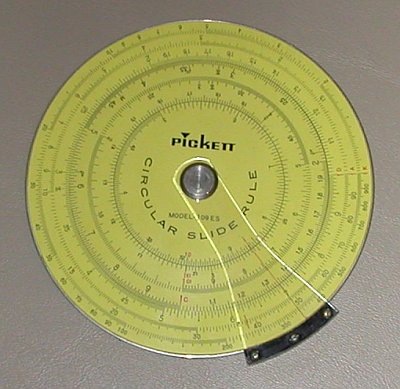
pickett circular slide rule
Regular readers of this blog (all five of them) will know that, Selective Luddite™ that I am, I'm a fanatic about slide rules. I keep a slide rule on my desk, and often use it in preference to a calculator. My interest in slide rules dates back to my high school days, in the early 70s, when they were still teaching us in math class how to use slide rules. I got a few slide rules when I was in high school, and I still have a couple of them, including the slide rule pictured here: a Pickett circular slide rule, model 109ES.

This really is something of an oddity. The advantage of a circular slide rule, of course, is that you can never run "off the end" of a scale. Also, it's much more compact: only 4 inches in diameter, my circular slide rule has scales more detailed than those on a standard 10-inch slide rule.

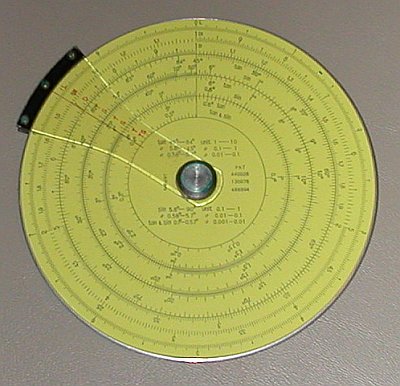
pickett circular slide rule
The front has EI, CI, C, D, A, and K scales. The back has L, DI, and D scales, plus half a dozen sine and/or tangent scales. Looking back, I wish I'd thought to buy a slide rule with log-log scales on it: somehow that idea never occurred to me in high school.

Then I went with calculators, which were just coming out and becoming affordable around that time, and for many years I was an apostate from the world of slide rules. Then I began rediscovering those slipsticks, at second-hand stores and antique stores and garage sales. Over the past 10 or 12 years I've built up something of a slide rule collection. But I've never run across another circular slide rule like that one I got back in high school.

Labels:

Thursday, May 25, 2006

Lightning Adding Machine

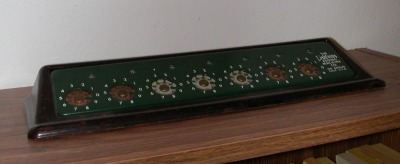
lightning adding machine
Here's an odd item I ran across years ago in a second-hand shop. The Lightning Adding Machine.

The metal mechanism sits in a stand made of bakelite. You can turn the metal dials with a stylus, and when a dial goes past 9, the next dial increments by 1. Numbers show in little windows above the dials.

An included instruction sheet shows how you can use this device to add, subtract, multiply, or divide. "As simple as dialing a phone... and instant in response!" You could order another Lightning Adding Machine for only $12.95 postpaid, from the Lightning Adding Machine Co., 543 S. Spring St., Los Angeles 13, Calif.

Just from the look of things, I'd guess that this little mechanical adding machine dates from the 1940s.

Labels:

Tuesday, March 28, 2006

The Moonstick: A Moon Phase "Slide Rule"

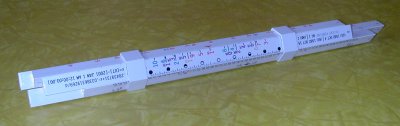
moonstick
I ran across the moonstick several years ago, and with my interest in slides rules, I was hooked. Actually the moonstick isn't exactly a slide rule, but it sure is a soul brother to slide rules.

Hexagonal in cross section, with six "slides": five of them can slide back and forth, the sixth is fixed. With the aid of the moonstick you can calculate the phase of the moon for dates up to 8000 years into the past or future. It takes leap years and all that into account.

What was the phase of the moon on the day you were born? On December 7, 1941? On July 4, 1776? On October 14, 1066? The moonstick can also be used to answer questions such as, when is the next time there will be a full moon on April 1?

Like I say, it's a soul brother to the slide rule. The moonstick is funky. You look at it and you wonder why somebody didn't invent it ages ago. It's that cool, and that ingenious.

You can get a moonstick of your own right here. Check it out!

Labels:

Saturday, February 18, 2006

A Dream on a Cold Winter Night

17° below zero out last night, and as I lay warm beneath two heavy wool blankets, I had a dream...

I bid the others farewell. We were standing in something like a high school cafeteria. I would see them again later. Now I turned and walked off down a long hallway, with tiled floor.

As I walked down the hall, I came to some tables set off along one side. These tables were piled with all sorts of junk, which was being given away for free, otherwise it would be thrown out. I stopped to inspect.

slide rule obverse
On one table I found some large plastic trays full of slide rules. I checked them out. There were some Chinese slide rules, marked with curious characters in Chinese. There were some circular slide rules. There were even some circular Chinese slide rules.

I was thinking of how many of these slide rules I could add to my slide rule collection at home. But I didn't want to seem greedy, so I only picked out two slide rules to take with me. I also found a deck of playing cards from China, with a back design something like Walt Disney's Magic Kingdom.

slide rule reverse
Then I walked off down the hall. But before I had gone far, I decided to go back. I went back and started picking out more slide rules, one of every different design. People were walking by down the hall, seeing me standing there by the tables, the glutton for slide rules. I didn't care. If I didn't take these slide rules, they would only be thrown out anyway.

And then I woke up.

Labels: ,

Friday, October 21, 2005

Slide Rule Universe

K&E 4081-3 front (detail)
   (Click on this and all pictures for a complete full-size view of the slide rule)

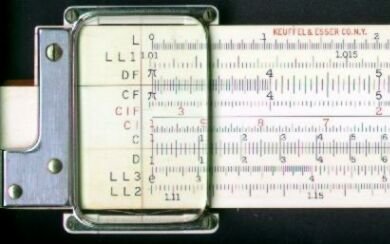
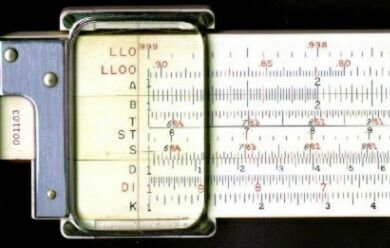
I've blogged before about my interest in slide rules. I have a collection of a few dozen slide rules, and my favorite is a Keuffel & Esser Log Log Duplex Decitrig, model 4081-3, from back around 1940. The 20 scales are machine ruled on celluloid, over a core of mahogany. The front of the 4081-3 is pictured above, and here's the back:

K&E 4081-3 back (detail)
I have this slide rule sitting in its leather case on my desk, and I often use it in preference to a calculator.

Yesterday my friend David e-mailed me, complete with pictures, about a slide rule that he's got. And it looks to me like virtually the same model as mine! His has a "K+E" symbol on one side that mine doesn't, but otherwise they are the same slide rule. What can I say? Great minds have the same taste in slide rules! :-)

K&E 4081-3 front
There are a number of slide rule sites out there, but without a doubt the greatest is Walter Shawlee's Slide Rule Universe. Tons of pictures of more slide rules than you can shake a stick at (if you'll pardon the pun :). Tons of info. Plus slide rules for sale.

K&E 4081-3 back
A few years ago, I picked up a Post Versalog 1460 at an antique shop over in Decorah. Very nice, except the little glass cursor window on the back was missing. I contacted Slide Rule Universe out in Vancouver, BC, and obtained a replacement part. The Versalog is probably my favorite slide rule, next to that K&E 4081-3 that I've got sitting on my desk.

One of these days, I intend to get my entire slide rule collection up on my personal website. In the meanwhile, you can see a few of my favorites from my collection here.

Labels:

Friday, May 13, 2005

Slide Rules

Obi-Wan Kenobi somewhere refers to the light saber as "an elegant weapon from a more civilized time." Yeah, that's sort of how I feel about slide rules...
K&E 4081-3 front (detail)
   (Click on this and all pictures for a complete full-size view of the slide rule)

Understand, I was originally going to be a mathematician. In fact I spent three years as a teaching assistant in the math department at the University of Wisconsin-Madison. In those days I had a string of calculators, which were then a fairly new item. True, in high school we'd learned to use slide rules. But calculators had rendered slide rules obsolete... hadn't they?

It was only many years later that I began running across old slide rules at garage sales, at St. Vincent's, in antique malls. I still had an old circular Pickett from my high school days. I've accumulated a small but nice collection of about two dozen different slide rules.

My favorite is the Keuffel & Esser Log Log Duplex Decitrig, model 4081-3, from back around 1940. The 20 scales are machine ruled on celluloid, over a core of mahogany. The front of the 4081-3 is pictured above, and here's the back:
K&E 4081-3 back (detail)
I have this very slide rule sitting in its leather case on my desk, and I often use it in preference to a calculator. Hey, you can figure things on it just as fast as on a scientific calculator, and it doesn't need batteries.

It provides answers to only three significant figures, but in the real world, that's all the precision you need anyhow. Multiplication, division, reciprocals, square roots, cube roots, logarithms, sines, tangents, any powers or roots you want... a "slipstick" like my K&E Log Log Duplex Decitrig can work problems involving all these and more.

In fact, I must confess I'm something of a Selective Luddite™, and of that my slide rules are one sign. I know in the blogosphere it's fashionable to say, "I'm no Luddite!", as if to reassure everyone, with a slightly strained air: "Me okay! Me okay!"

Well, I don't particularly care whether I'm "okay" or not. Often "okay" simply means you've learned "good citizensheep." As for science and technology, I love them— only I aim, insofar as I can, to control their role in my life. Not to let them control me. And in particular not to let our cultural interpretations of science and technology control me.

I repeat, I love technology. But only if, in my judgment, that technology enriches my life. Only if, in my judgment, that technology adds to my convenience, or to my being in greater control of my life.

Technology which impoverishes my life— which makes my life more of a hassle— which ends up controlling me instead of me controlling it— technology like that, I'll do without, if I can at all get away with it.

And that's why I've got on my desk both a computer and a slide rule. And why I've so far avoided getting a cell phone; in fact, I only just barely tolerate telephones at all. (Idea for a science fiction story: somebody travels back in time, and strangles Alexander Graham Bell in his cradle.)

K&E 4081-3 front
But a slide rule is both physically and conceptually a thing of beauty. Physically, that solid mahogany, those finely machined scales... my slide rule, like I say, dates back to about 1940, and I suspect that to someone of that era, the stainless steel endpieces would stand out, too. I mean, that whole beautiful slide rule of mine is just so New York World's Fair...

Physically. And conceptually... conceptually you find yourself in close quarters with numbers and with mathematical functions when you're using a slide rule. You can do math by punching buttons on a calculator, without really understanding what you're doing. But to do math with a slide rule is to gain a deep acquaintance with math and with numbers.

A deep acquaintance with math and with numbers; and, if you will, with depths deeper than mere mathesis.

Observe, for instance, how numbers seem to us to be important, significant, "thick," with a weighting roughly proportional to their distribution on the LL3 scale of a slide rule. Each of the lower integers has its own very distinct "personality"— note how 2 appears lower down, on a scale of its own, and how 1 does not appear on any log-log scale at all, no matter how low you run— then the distinctiveness of the integers gradually shades off as you go higher, and gives way to the distinctiveness of decads and hektads and chiliads and myriads, each order of magnitude now of roughly the same weight as the entire order of magnitude preceding it. And, somewhere up around five, ten, twenty thousand, the numbers shade off into a vague multitude "as vast as the stars in the sky, as numerous as the sands of the seashore."

If numbers have weight, feel, the sort of heft which a good tool has when held in the hand— then this is roughly the distribution of their weighting. It looks very much like a logarithmic distribution, very much like the LL3 scale on a slide rule.

This is an insight which surely the ancient Pythagoreans would have appreciated. And, philosophical realist that I am, I cannot but feel that here is symbolized some deep objective truth about the numbers themselves— about Reality with a capital "R". But among moderns, as the poet and philosopher Samuel Taylor Coleridge noted in his Biographia Literaria, there seems to be an unspoken agreement never to say anything this "deep" about the way things are.

K&E 4081-3 back
Still, you don't have to settle for "good citizensheep" and being "okay." Nor for Luddism plain and simple. No, you can stand on your own two feet, and be a Selective Luddite™. Don't let technology, or worse yet our facile cultural interpretations of science and technology, deaden your soul. Use and enjoy the fruits of science and technology, rejoice in them; only you use them, don't let them use you. Let them enhance and deepen your soul, not deaden it.

</hippie-dippie quasi-sixties rant> :-)

Someone has observed that one of the cool things about the slide rule is that the ancient Romans could have had slide rules, if only they'd had the concept of logarithms. This is true, though with Roman numerals a slide rule would still have been a difficult thing to conceptualize.

Easier to imagine is the idea of the ancient Mayans having had slide rules, with their positional number notation in base twenty, and the notion of zero. If only the Mayans had had logarithms... I can just imagine a Mayan slide rule, inlaid with jade, vigesimal, incised with curious Mayan hieroglyphics...

Labels: , ,