Wednesday, October 17, 2007

The Republic of New Netherland
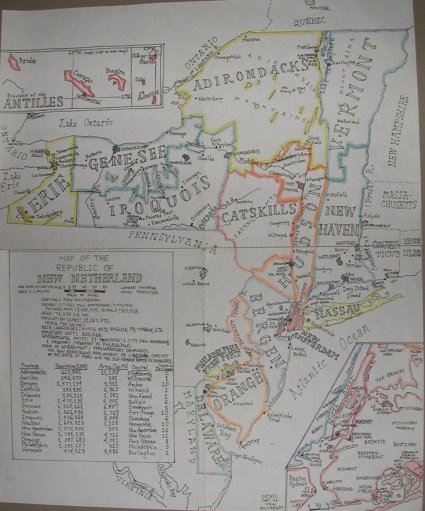
map of new netherland
Fig. 1  Map of the Republic of New Netherland

Once upon a time in an alternate history, the Dutch did not lose their North American colony to the English. On today's East Coast, between New England and the rest of the United States, stands the Republic of New Netherland. Or, as its own citizens call it in Dutch, de Republik van Nieuw-Nederland.

This is yet another fruit of my "radioactive core meltdown of the imagination." Actually I started working on New Netherland late, going into my mid 20s. I continued to work on it for ten years or more. Can't claim I've worked on it much since the early 1990s.

But talk about detail! I've got a list of every radio station in New Netherland, location, frequency, call letters, daytime and nighttime transmitter power. All the major highways, all the railroads. The 1980 census. The major league baseball teams of New Netherland's Knickerbocker League. A detailed history of the country. Reminiscences of the best (and worst) spots to smuggle goods in across the border from the United States. For New Netherland, you know, is a country unto itself.
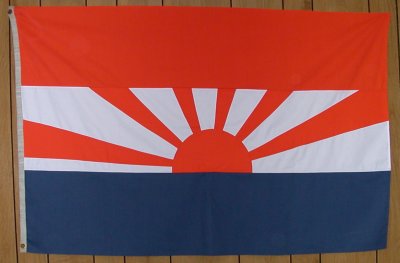
flag of new netherland
Fig. 2  Flag of the Republic of New Netherland

To this day, hanging on the wall, I've got an actual full-sized flag of the Republic of New Netherland. Orange and white and blue, the old flag of the Prince of Orange, with a rising sun emblazoned on the middle stripe. I even composed the tune of New Netherland's national anthem, Onze Patrie (Our Fatherland): I've been known to astound friends by whistling it clear through from beginning to end.

The history of New Netherland begins, as in our timeline, with Henry Hudson exploring on behalf of the Netherlands, sailing up the Hudson River as far as the site of the present day Fort Orange [Albany]. The Dutch West India Company made a settlement in 1624, and in 1626 New Amsterdam was founded on Manhattan Island.

My alternate history diverges from our timeline in 1638, when David Pietersen de Vries (and not Willem Kieft) was appointed Director-General of New Netherland. As one history book puts it:
[In choosing] de Vries for the post... the States-General at a single stroke almost certainly prevented the Dutch colony in North America from eventually slipping out of their grasp...

De Vries had been a merchant skipper before coming to New Netherland. He was by all accounts a remarkable personality: shrewd, clear-headed, conciliatory but firm. De Vries was humane but unyielding in pressing forward to his goals... De Vries' first measure was to press for ending the fur trade monopoly of the Dutch West India Company. At the same time, he launched an intensive and successful campaign in Europe to draw a greater number of settlers to New Netherland. De Vries saw that the Dutch colony in the New World, if it was to survive, must become a true colony, and not just a station for a trading company.
De Vries established good relations with the Five Nations of the Iroquois. He fostered a degree of self-government in the colony with the setting up of the College of Twelve, which was the forerunner of today's New Netherlander Parliament. He pressed for the Connecticut River [Varsche Kill] as the boundary between New Netherland and the English colonies in New England, and he annexed the Swedish colony of New Sweden, along the Delaware River [South River, Zuid Kill] as the Dutch colony of New Amstel.

Most importantly, when the English sent four frigates in 1664 to take the chief colonial city of New Amsterdam:
They found a well-fortified city of eight thousand souls; de Vries had ordered the city prepared for the defense. In the ensuing battle, Dutch cannon sunk two of the English frigates, and the remaining two fled amidst fearsome volleys from the shore. The English attempt to seize the Dutch colonies in America had failed.
The English were eventually to recognize the Dutch title to New Netherland. De Vries was succeeded on his death by Hendrik Watervliet as Director-General. It was Watervliet who concluded an accord with his personal friend, William Penn, to establish the city of Philadelphia as a city under Dutch sovereignty with free trade rights to and from Pennsylvania through Philadelphia. Watervliet also oversaw the organization of the two provinces of Hudson and the Catskills in the valley of the Hudson River [North River, Noort Kill], where Dutch patroons with their land-grant feudal manors had been vying with one another for influence and power.

The Dutch remained neutral during the American Revolution. But New Netherland found itself on the path to independence when Napoleon Bonaparte seized the Netherlands in 1795. Director-General Philip Schuyler assumed administrative control of the Dutch colonies in the New World. A convention was gathered in New Amsterdam, and in 1798 the Constitution of the independent Republic of New Netherland was proclaimed.

Schuyler became the first Prime Minister of New Netherland, though he soon stepped down due to ill health. He was succeeded as Prime Minister by the patroon Stephen van Rensselaer. The first party divisions emerged, between the Conservatives ("Long Pipes") and Liberals ("Short Pipes").

The great New Netherlander statesman of the 19th century was Maarten van Buren, who became Prime Minister in 1820, and held the post for most of the next 36 years. This was the era when the Erie Canal was constructed, which for a time made New Netherland a major power in commercial transport to and from the interior of North America. This was also the era of the Anti-Rent War (1841-46), which ended in the patroons being stripped of their feudal manorial powers and reduced to a mere titled nobility.

Anti-slavery sentiment fueled New Netherlander aid to the Union in the Civil War, especially after Schuyler Colfax became Prime Minister (1863-77).

Theodore Roosevelt served as Prime Minister for most of the period 1897-1919, and New Netherland entered World War I in 1917 on the side of the Allies.

With the stock market crash in 1929, the Conservative government of Vermonter Calvin Coolidge resigned by the spring of 1930, and Franklin Delano Roosevelt headed up a Liberal government until his death in 1945. This was the period of the Great Depression and World War II, which New Netherland entered in 1940. FDR is also remembered for the constitutional crisis of 1935, when he extended the term of his government, and postponed national elections, one year beyond the constitutionally mandated five-year limit.

In 1948 Quentin Roosevelt, son of TR, became Prime Minister and led a Conservative government which continued until his death in 1965. It was the 1960s: three governments fell in the next 18 months, followed by the government of the first Iroquois Prime Minister of New Netherland, Oren Lyons (1967-74), under whom New Netherland broke with the US and by 1968 withdrew its forces from Vietnam. The tempestuous Lyons era was brought to an end in late 1974, when the President of New Netherland, a purely ceremonial appointive post, forced a constitutional crisis by asserting authority to unilaterally dissolve Parliament and call for elections.

Liberal Prime Minister D. Patrick Moynihan found his own party split between moderates and radicals, and he was forced to form a coalition "Neo-Conservative" government of Conservatives and moderate Liberals. In 1983 Jack Kemp became Conservative Prime Minister. The current Prime Minister of New Netherland is Rudy Giuliani.

The Government: The Parliament [Landdag] of New Netherland is comprised of two houses, the lower House of Burghers and the upper House of Peers. In practice, virtually all legislative power is vested in the House of Burghers. This lower house consists of 120 burghers, popularly elected, and apportioned among the provinces proportional to their populations as determined in a decennial census. The House of Peers consists of 40 patroons, five Iroquois chiefs, about 50 hereditary peers, about 150 life peers, one steward of the freeport, seven chancellors, and such other members as the House of Peers may itself admit (such as the President of New Netherland, the ambassador to the League of Nations, etc.).

The Prime Minister may choose his cabinet either from within or from without the Parliament, including such cabinet posts as the Koopman (secretary and parliamentarian of the cabinet), the Schout-Legal, the Schout-Fiscal, etc.

Political Parties: The two largest parties in New Netherland are the Conservative Party and the Liberal Party. Other parties which usually capture at least a few seats in Parliament are the Labor Party, the Socialist Party, and the right-wing Independent Progressive Party. The Communist Party reliably polls a number of votes, but has not held any seats in Parliament since the 1930s.

The Provinces: New Netherland is divided into 13 provinces, one city (New Amsterdam), and one freeport (Philadelphia).

The Law: New Netherland derives its legal heritage from Dutch law, based on Roman law, with some influences and admixtures from the English common law adopted by osmosis from the surrounding United States. The highest appellate court in most cases is the Chancellory, whose seven chancellors are nonvoting members of the House of Peers. The powers of the Chancellory do not extend to judicial review of legislation, and in some legal matters (the Maritime courts, the Freeport, Iroquois affairs) there are other courts which function as court of highest appeal.

Languages: According to the 1980 census, Dutch was the first language of about 85% of the population of New Netherland; English, of about 9%; Iroquois languages (Mohawk, Oneida, Onondaga, Cayuga, and Seneca), about 6%; and French, about 0.1%. This does not include the complicated linguistic situation of the Antilles, with Papiamento, Spanish, Portuguese, etc.

Areas which are majority English-speaking include the cities of Philadelphia, New Haven, and Hartford, and also eastern Vermont and the east end of Long Island. Iroquois languages are spoken in the Iroquois province and also among the several hundred thousand Mohawks in New Amsterdam. There are important English-speaking minorities in New Amsterdam and in Buffalo, and a sprinkling of English speakers in many other cities of New Netherland.

The spoken Dutch in New Netherland has diverged somewhat from the Dutch of the Netherlands, but the two are still more or less mutually intelligible. Up through World War I, European Dutch was employed in New Netherland as the literary language. But today the literary language in New Netherland is based much more closely on the spoken language.

Radio: Far out into the American heartland, radio stations from New Netherland can be received at night: D2CO 880 New Amsterdam, D2CA 1210 Philadelphia, D2R 710 New Amsterdam, D2Y 810 Schaeneckstede, D2WH 1180 Irondequoit; to say nothing of the several shortwave stations from New Netherland; and also two longwave stations, D2YZ 216 New Amsterdam and D2G 252 Buffalo, which date back to FDR's public works projects in the 1930s.

The national radio network in New Netherland is NNRK [Nieuw-Nederlander Radiotelephonische Koorpershaft], and in the 1950s the government organized a second "cultural" radio network; but there are also many private and commercial radio stations. The national television network is the Orange Network, which for many years was presided over by the benign authoritarian figure of Colonel Cornelius ten Broek, World War II hero of the old New Netherland Signal Corps.

Military: New Netherland has an Army, a Navy, an Air Force, and also the Iroquois Native Guard (who make the US Marines look like pantywaists).

Intelligence: The intelligence agency of New Netherland is Bluelight [Blauwlicht]. Not to be compared to the FBI, CIA, or NSA. More like the Mossad. Quick, efficient, direct, and sometimes not too heedful of niceties.

Baseball: In the world of New Netherland, all major league baseball teams are located no further west than the Mississippi, and not much further south than the Mason-Dixon line. In addition to the US and its National League and American League, New Netherland has eight major league baseball teams in the Knickerbocker League: the New Amsterdam Knickerbockers, the Breuckelen Dodgers, the Bergen Nine, the Philadelphia Phillies, the Buffalo Bisons, the Irondequoit Skylarks, the Onondaga Iroquois, and the Hartford Yellow Sox.

Gasoline: Everywhere you go in New Netherland, it's Blue & White gas. Blauw en Wit— de gasolijn, die Nieuw-Nederland gaan laat! ("Blue & White— the gasoline that makes New Netherland go!") And probably that gas goes into your Selden economy sedan, Van Buren luxury car, or Herkul truck, all manufactured by the Selden Automotive Corporation in Irondequoit, Genesee.

United States: Still has 50 states, with the addition of Plymouth, Franklin, Lincoln, and Puerto Rico. American culture in the world of New Netherland has been centered much more in mid-sized cities such as Boston, Baltimore, etc. American Presidents in this alternate history include Henry Clay (1837-1845), Lewis Cass (1849-1857), Samuel Tilden (1877-1881), Philander Knox (1901-1909), Charles Hughes (1923-1929), and the Progressive Robert M. La Follette, Jr. (1933-1953).

And that's only scratching the surface. I have tons and tons of material on the Republic of New Netherland, up through the early 1990s. All set in a world where the Dutch never lost their North American settlements to the English...


Name: The Republic of New Netherland (Dutch: de Republik van Nieuw-Nederland).

Area: 71,288 square miles.

Population: (1980 census) 31,267,971.

Capital: New Amsterdam (Nieuw-Amsterdam).

Largest Cities: New Amsterdam (7,071,030); Philadelphia (1,688,210); Buffalo (357,870).

Languages: Dutch, 84.8%; English, 8.8%; Iroquois (Cayuga, Mohawk, Oneida, Onondaga, Seneca), 6.3%; French, 0.1%. Also a scattering of Spanish, Papiamento, and Portuguese in the Antilles.

Head of State: Eduard van Rensselaer, Patroon van Rensselaerwyck, President of New Netherland.

Head of Government: Rudy Giuliani, Prime Minister of New Netherland (Conservative).

Legislature: Parliament (Landdag): lower House of Burghers, 120 elected members; upper House of Peers, made up of appointed and hereditary members.

Currency: Guilder (fl.); fl.1 = US 27¢. 1 Guilder = 20 Stivers = 100 Cents.

Administrative Units: 13 provinces, 1 city, 1 freeport. All populations are 1980 census:
  1. Adirondacks (Adirondacken), pop. 625,845; area, 15,299 sq. mi.; cap., Plattsburgh; seats in parliament, 2.
  2. Antilles (Antillen), pop. 246,500; area, 385 sq. mi.; cap., Willemstad; seats in parliament, 1.
  3. Bergen, pop. 5,377,134; area, 3,381 sq. mi.; cap., Amboy; seats in parliament, 20.
  4. Catskills (Kaatskillen), pop. 399,890; area, 5,869 sq. mi.; cap., Wiltwyck; seats in parliament, 2.
  5. Delaware (Zwaanendael), pop. 595,225; area, 1,982 sq. mi.; cap., New Amstel (Nieuw-Amstel); seats in parliament, 2.
  6. Erie, pop. 1,475,195; area, 4,005 sq. mi.; cap., Buffalo; seats in parliament, 6.
  7. Genesee, pop. 1,320,161; area, 6,407 sq. mi.; cap., Irondequoit; seats in parliament, 5.
  8. Hudson, pop. 2,562,486; area, 5,765 sq. mi.; cap., Fort Orange (Fort-Oranje); seats in parliament, 10.
  9. Iroquois, pop. 1,496,868; area, 9,004 sq. mi.; cap., Onondaga; seats in parliament, 6.
  10. Nassau (Nassouwen), pop. 2,603,813; area, 1,218 sq. mi.; cap., Heemstede; seats in parliament, 10.
  11. New Amsterdam, City of (Stad van Nieuw-Amsterdam), pop. 7,071,030; area, 300 sq. mi.; cap., New Amsterdam; seats in parliament, 26.
  12. New Haven (Nieuw-Haven), pop. 2,788,395; area, 4,716 sq. mi.; cap., New Haven (Nieuw-Haven); seats in parliament, 11.
  13. Orange (Oranje), pop. 1,987,689; area, 4,087 sq. mi.; cap., Fort Nassau (Fort-Nassouwen); seats in parliament, 8.
  14. Philadelphia, Freeport of (Vrijport van Philadelphie), pop. 2,243,217; area, 320 sq. mi.; cap., Philadelphia; seats in parliament, 9.
  15. Vermont, pop. 474,523; area, 8,486 sq. mi.; cap., Burlington; seats in parliament, 2.

Labels:

Wednesday, June 20, 2007

A Star System of My Own

A quick index of my posts on an entire star system I made up:

1. Hinkson's Tourmaline, Hinkson's Garnet, and Their Planets

2. The Double Planet of Catseye and Eclipse a/k/a Hinkson Tourmaline IV

3. The Native Life Forms of Hinkson Tourmaline IV

4. The Calendar of Hinkson Tourmaline IV

Labels: ,

Tuesday, June 19, 2007

A Star System of My Own, Part 4

Continued from Part 1, Part 2, and Part 3

calendar cards
William S. Burroughs once compared Time magazine to the Mayan calendar, which told people which days were fortunate or inauspicious, which days to feel happy or sad. The calendar in use on Hinkson Tourmaline IV was likewise densely interwoven with the rhythm of everyday life, though in a mode quite different from any calendar ever dreamt of on Earth.

Settlers on Hinkson Tourmaline IV were spread out across the face of the planet, most of them in the habitable/arable zones near oceans or other bodies of water, and many of them around the Third Ocean on the Catseyeward side of the planet. Here they could never forget why the official name of Hinkson Tourmaline IV in the planetary register was the planet Eclipse; for overhead the planet Catseye loomed huge, stretching across a sixth of the sky. The star Hinkson's Tourmaline was eclipsed by Catseye every day, so that the daily cycle consisted of morning, afternoon, night, and also midnight noon whose darkness clove and divided morning from afternoon.

Catseye overhead by day, a huge crescent waning and waxing, reduced to darkness in the dark sky during the hour of midday totality. A dark sphere with lightning and auroral displays raging across its face in the dark overhead. Then at night, after Hinkson's Tourmaline had set and the sky grown dark, Catseye above waxed to full, lighting up the night like a hundred full moons, and across the face of Catseye moved the round shadow of Hinkson Tourmaline IV, like the black pupil moving across a rolling eye. And again, with lightning raging in the pupil of the eye, in the night sky overhead...

Burroughs was right. Night and day and sky determine the calendar, and then calendar and environment determine the rhythm and feel of day-to-day. Day and Year and Week and Month...

Day:  Hinkson Tourmaline IV, which always keeps the same side toward its primary, the large terrestrial planet Catseye, both rotates around Catseye and revolves on its axis once every 13.738 hours. Thus the Day is reckoned as a period of 13.738 hours.

On the primaryward side, the primary eclipses Hinkson's Tourmaline daily. Transition to or from totality takes only about a minute, and totality lasts about 62 minutes at the equator. Eclipse is slightly shorter at higher latitudes.

In most settlements on Hinkson Tourmaline IV, day is held to begin at local sunrise. But in some settlements on the Catseyeward side of the planet, the new day begins at the end of the morning, at the first moment of total eclipse at the onset of "midnight noon." Local calendar variations like this arose in the early days of colonization, when various human settlements on the planet were widely dispersed and struggling, and often not in regular communication with one another. These differences have never been ironed out, due in part to the peculiar role the day plays in the calendar of Hinkson Tourmaline IV (see Week below).

Year:  The Catseye/Eclipse double planetary system revolves in its orbit around Hinkson's Tourmaline once every 528.67 Earth days. Thus a year on Hinkson Tourmaline IV lasts 923.57 local days.

Accordingly, the calendar year is 924 local days long. Three years out of seven are "short years," only 923 days long. A "short year" drops its last day. A year is a short year if, when divided by 7, the remainder is odd (1, 3, or 5).

The Hinkson's Year era (years HY) begins with 1 HY, which is dated from the first planetfall of the H.H. Hinkson expedition on Hinkson Tourmaline IV in AD 2172.

Week:  Catseye turns on its axis precisely twice every three local days, so every three days Catseye presents the same aspect in the sky overhead at the same time of the day. This leads to a three-day rhythm in the week: Foreday, Middleday, and Hinterday. Four such three-day periods constitute one week of twelve local days:
  1. Green Foreday
  2. Yellow Middleday
  3. Red Hinterday
  4. White Foreday
  5. Green Middleday
  6. Yellow Hinterday
  7. Red Foreday
  8. White Middleday
  9. Green Hinterday
  10. Yellow Foreday
  11. Red Middleday
  12. White Hinterday
The four-day rhythm of Green, Yellow, Red, White, leading to a twelve-day week, was a concession to the fact that the local day is little more than half the length of an Earth day. A few of the colonists actually held a waking and sleeping cycle of one local day of 13.738 hours; but most colonists fit their waking and sleeping, their cycle of "daily" activities, some into a period of two local days (27.476 hours), some into a period of three local days (41.214 hours). And some even held to a "day" of four local days (54.952 hours).

A twelve-day week accommodates all of these "daily" cycles. Which length of cycle one followed was to a large degree a family-by-family choice, though it was also to some degree a matter of locale, cycles of a given length being more popular in one settlement than in another. And sometimes a particular cycle was common to a guild or trade.

This led to a culture in which one's daily schedule faded into and out of sync with one's friends and neighbors. Today, your schedule and mine might come into alignment so that we might meet for lunch at what was for both of us midday; a few days later, and my workday might coincide with the middle of your night. Not exactly a lazy schedule of "mañana," but a schedule in which phases come and go, fade in and out, in ever drifting evanescence. Half the world is sleeping while I am awake; and not always the same half, either.

And even if we both keep to a cycle of the same duration, I might wake and work during Foreday and Middleday, and sleep during Hinterday; while you might be up Middleday and Hinterday, and asleep Foreday.

Nor did sky in its light and darkness mark the bounds strongly: the nighttime was lit up by the light of Catseye overhhead, and every midday was plunged into an hour of deep darkness. No matter what the length of your "day," you could not escape a cycle in which both light and darkness featured in both your waking and your sleep time.

Think for a moment what it would be like to live in a world where day and night, waking and sleeping, light and dark, and most of all my schedule and yours, shifted and slid in the fleeting and evanescence of such a hall of mirrors.

Months:  Catseye and Hinkson Tourmaline IV share two small moons which orbit their common center of gravity: the Lion, visible in the sky as a small yellow disk, with a period of 21.38 days; and the Tiger, visible as a brilliant orange star, with a period of 43.89 days. These suggest two mensal periods of 21 days (called a "leo") and 44 days (called a "tigger").

Coincidentally, the product of 21 and 44 is 924— the number of local days in a year! Moreover, 21 and 44 are relatively prime. Thus if these two cycles run concurrently, each will fill out a long (924-day) year evenly, and each of the 21 "days of the leo" will coincide with each of the 44 "days of the tigger" once and only once during the year. A year will be made up of:
  • 77 weeks of 12 days each
  • 44 leos of 21 days each
  • 21 tiggers of 44 days each
So a day of the year can be uniquely identified as, for example, "5 Lion 37 Tiger"— meaning that it is the 5th day of the current leo, and the 37th day of the current tigger. The day after 5 Lion 37 Tiger would be 6 Lion 38 Tiger, and the day after that would be 7 Lion 39 Tiger. And the day after 12 Lion 44 Tiger would be 13 Lion 1 Tiger.

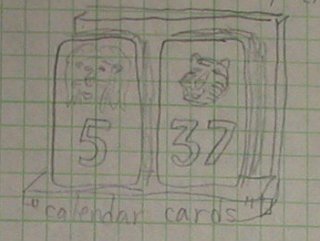
calendar cards
Combining days of the leo and tigger with the days of the week yields the complete way calendar days were specified on Hinkson Tourmaline IV. For instance, today might be Red Middleday 5 Lion 37 Tiger. And then tomorrow would be White Hinterday 6 Lion 38 Tiger, and the day after tomorrow would be Green Foreday 7 Lion 39 Tiger. (This does sound vaguely like the Mayan calendar, doesn't it?) There were calendar cards in common use, 21 for the days of the leo and 44 for the days of the tigger. They were usually displayed in two piles set up on a rack. Every day, the top card on each stack would be moved to the back of its pile.

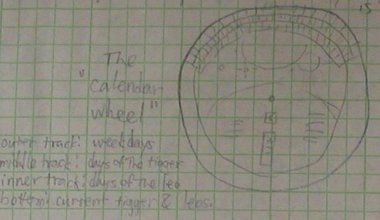
calendar wheel
The question "Which leo and which tigger of the year is it?" can be answered by aligning the yellow 5 and orange 37 on a common device known as the calendar wheel, which also usually includes a track for days of the week. This device, if adjusted once every tigger, can also serve as a sort of perpetual monthly calendar.

In a short year of 923 days, the last day of the year (21 Lion 44 Tiger) is omitted, but the twelve-day week continues without interruption, so that if the last day of the old year was Yellow Foreday 20 Lion 43 Tiger, the first day of the new year would be Red Middleday 1 Lion 1 Tiger. Under this system, the weekdays shift by one day in the year following a short year, but remain the same from one year to the next in the year following a regular (924-day) year.

Note how the calendar of Hinkson Tourmaline IV, with its two intertwining mensal periods of Lions and Tigers, is better adapted to answering the question, "Where am I in the superimposed rhythm of various cycles?", than to answering the question, "Where am I in the year considered 'in the large'?" Such a calendar is better adapted to a world where numerous cycles predominate, and the seasons of the year are not so strongly marked. Catseye and Hinkson Tourmaline IV both have essentially zero axial inclination toward the plane of their revolution around each other, and this plane is inclined at only about 9° toward the ecliptic. Thus there are seasons on Hinkson Tourmaline IV, though they are much less strongly marked than on Earth with its 23° axial tilt. And the seasons were even further moderated for most of the settlers, living as they did near one of the oceans.

And there you have it, a star system of my own! I have tons of items like this stored away in all those zillions of boxes of old papers I've got stored away. Goes along, I think, with my overall radioactive core meltdown of the imagination.

Labels:

Monday, June 18, 2007

A Star System of My Own, Part 3

Continued from Part 1 and Part 2

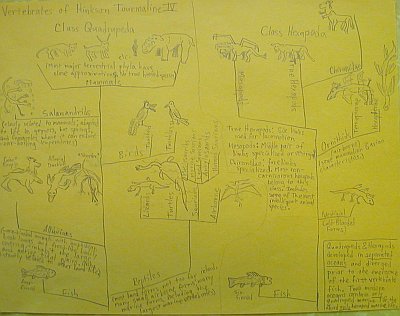
vertebrates of hinkson tourmaline iv
The vertebrate life forms native to Hinkson Tourmaline IV are divided into two broad categories, four-limbed and six-limbed. Quadrupeds and hexapods developed in separated oceans and diverged prior to the emergence of the first vertebrate fish. Two modern oceans contain only quadruped marine life and four-finned fish; the third ocean contains only hexapod marine life and six-finned fish.

quadruped mammals
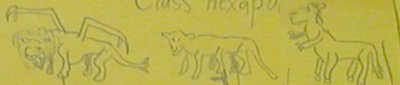
Most major terrestrial phyla have close approximations among the quadruped mammals of Hinkson Tourmaline IV. Note, there are no true hoofed species.

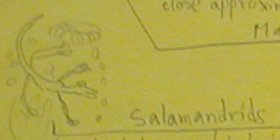
salamandrids
Salamandrid species are closely related to the mammals. They are adapted to life in geysers, hot springs, and fumaroles, where they can endure near boiling temperatures.

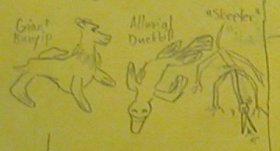
alluvians
Alluvians are warm-blooded animals with amphibian book lungs and a frond-like bodily covering. A wide variety of alluvian species, such as the giant bunyip, the alluvial duckbill, and the skeeter, inhabit the large and active coastal tidal plains around the oceans and other bodies of water. Tides of up to 100 feet not being unusual, these tidal plains are often several miles wide. Alluvians are only distantly related to other land life.

birds
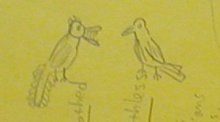
The birds of Hinkson Tourmaline IV are divided into toothed birds and toothless birds.

reptiles
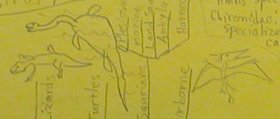
The quadruped reptiles include land-based lizards and turtles. They also include airborne lizard species, and a wide variety of saurians, including pleseiosaurids and other marine saurians, land saurians, ankylosaurids, and horned saurians.

hexapod mammals
The hexapod mammals of Hinkson Tourmaline IV are generally more specialized than the quadrupeds. The hexapods tend to occupy narrower ecological niches, but they usually predominate strongly in those niches.

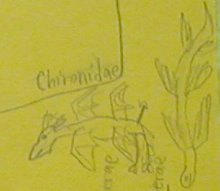
Hexapod mammals include various mesopod species, where the middle pair of limbs is either for specialized use or else vestigial. They also include a variety of true hexapods, where all six limbs are used for locomotion. And they include various species of chironidae, where the forelimbs are specialized; most non-carnivorous hexapods belong to this class, which also includes some of the most intelligent animal species.

ornithids
The ornithids include a variety of airborne hexapod species, with some mammalian and some avian characteristics. The ornithids are divided into hexapterae, with all six limbs more or less winglike; and tetrapterae, with four limbs winglike and the rear two limbs specialized or footlike.

There are also marine hexapods, including some large saurians and some hexapod porpoiselike species; as well as a few vestigial land-based cold-blooded hexapod life forms.

Tomorrow: The calendar of Hinkson Tourmaline IV.

Labels:

Saturday, June 16, 2007

A Star System of My Own, Part 2

Continued from Part 1 yesterday

double planetary system
As detailed previously, Hinkson's Tourmaline is a yellow-white class F7 star, part of a binary star system 41 light years from Earth. The fourth planetary orbit around Hinkson's Tourmaline is occupied by a double planetary system consisting of the two planets Catseye and Eclipse. The two planets, separated by a mean distance of 35000 miles, rotate about their common center of mass every 13.738 hours. The smaller planet, Eclipse, is relatively earthlike, and habitable for human settlers.

Catseye/Eclipse.  Distance from primary: 119,000,000 miles. Period of revolution: 528.67 days. Orbital eccentricity: 0.0016. Number of satellites: 2.

The planets Catseye and Eclipse share two small moons, called the Lion and the Tiger, which orbit further out around their common center of mass.

Catseye.  Diameter: 17500 miles. Sidereal period of rotation: 20.607 hours. Volume (Earth = 1): 10.76. Mass (Earth = 1): 6.46. Density (g/cc): 3.3. Surface gravity (Earth = 1): 1.32. Albedo: 0.41. Mean subsolar surface temperature: 255° K. (0° F.)

Catseye is a very large terran planet, with a diameter of 17,500 miles. It is relatively poor in heavy elements; much even of its molten core consists of silicon and aluminum rather than iron-nickel compounds. The planet has active plate tectonics, and much vulcanism.

As a result of tidal braking between Catseye and Eclipse, Catseye turns on its axis twice for every three revolutions of its secondary companion.

The atmosphere, with a density of 3.75 Earth atmospheres (2850 mm Hg), is a reducing atmosphere containing nitrogen, methane, ammonia, free oxygen, water vapor, carbon dioxide, and ozone. Most of the surface is covered with ice and glaciers. Were the surface water in liquid form, most of Catseye would be covered with ocean. however, only near the equator do temperatures sometimes rise above freezing, and there is no place on the planet's surface (except for some volcanic vents and hot springs) that does not experience freezing.

Interaction with the strong magnetic field of Eclipse causes a continuous zone of auroras and electrical/lightning activity sweeping around the equatorial zone of Catseye. Thus there are organic compounds in abundance. However, Catseye itself has only a weak magnetic field. Due to lack of protection from radiation and charged particles, undependable availability of liquid water, and scarcity of heavier elements, the life forms native to Catseye are extremely primitive, rather like those of Earth during its Pre-Cambrian period.

Eukaryotic life forms include mostly algae, lichens, and one-celled animal life. The most advanced form of life resembles the earthly euglena colonies. Multi-celled life forms evidently have evolved relatively recently in planetary history. Many anaerobic prokaryotic life forms survive in equatorial regions. And even primitive self-replicating clay structures continue to exist near hot springs and fumaroles, where, apparently, life on Catseye first emerged.

A matter for concern is the careless introduction of terran micro-organisms into the ecology of Catseye by early expeditions to the system. Even such a simple organism as the intestinal bacterium E. coli has few competitors, and is vastly more efficient than the native organisms.

Eclipse.  Diameter: 7100 miles. Sidereal period of rotation: 13.738 hours. Volume (Earth = 1): 0.72. Mass (Earth = 1): 0.79. Density (g/cc): 6.0. Surface gravity (Earth = 1): 0.977. Albedo: 0.26. Mean subsolar surface temperature: 284° K. (52° F.)

The planet Eclipse is an earthlike planet which is in close orbit with its larger neighbor, the planet Catseye. The two planets are separated by a distance of only 35,000 miles, not much greater than their Roche limit. The planet Eclipse rotates on its axis once every 13.738 hours, always keeping the same face turned toward Catseye, which looms huge in the sky overhead on the Catseyeward side of Eclipse.

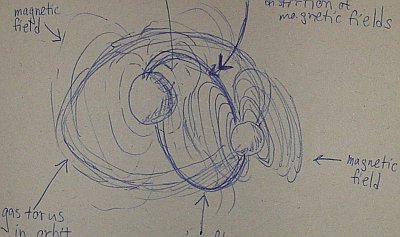
There is a complex system of interactions between the two planets, which is even yet not well understood. Catseye has a weak magnetic field, but Eclipse has a much stronger magnetic field which interacts with and distorts the field of its larger companion. The magnetic field of Eclipse also causes auroral and electrical phenomena where it intersects with the atmosphere of Catseye, and these phenomena are readily visible to the human settlers on Eclipse. Moreover there is an ion flux tube of several million amps between the two planets; and a significant gas torus fills the orbital path of Eclipse. Beyond that, the magnetic field of Eclipse also evidently exerts an influence on electric currents, magnetic field generation, etc. within the mantle and core of Catseye. It is hypothesized that this entire complex system contributes toward maintaining the two planets in orbital homeostasis around each other.

Eclipse's orbit around Catseye is of extremely low eccentricity, departing from the circular by only a few hundred yards. Catseye raises huge tides in the oceans and even the lakes on Eclipse. Tides of 100 feet are not uncommon along the seashores, giving rise to broad coastal tidal plains several miles wide which are flooded regularly.

On Eclipse the atmosphere is very similar in content and density to Earth. The oceans are of much lesser extent, covering less than half the surface of the planet. In fact there are three large disconnected oceans, in addition to a number of smaller lakes and salt lakes. Much of the most habitable land is located within several hundred miles of the oceans, its precise extent depending on geography, rainfall patterns, and local climate. There are also smaller habitable zones around lakes, and in remote oases. Land far removed from any body of water is known as "the Outback," desert at tropical or temperate latitudes, and dry tundra at arctic and subarctic latitudes.

The planet Eclipse was first visited and extensively explored by the Hinkson expedition in 2172. Human colonization began with the arrival of a Solar Federation starship about 100 years later. Most of the human colonists settled in the more habitable and arable zones near large bodies of water, and many of these settled around the ocean on the Catseyeward side of the planet.

To the colonists, the official name "Eclipse" is a "book" name for their adopted homeworld. One rarely hears the human inhabitants of the planet refer to their world as anything other than Hinkson Tourmaline IV. Note, without the possessive: it is Hinkson's Tourmaline, but Hinkson Tourmaline IV.

So there you have my science-fictional world of Hinkson Tourmaline IV. Looking back at my calculations, I suspect the two planets are too close together for comfort: I was very aware of the issue of the Roche limit, which I first discovered at age six in a story in DC's Mystery in Space comics— you know, the one with the classic cover showing Adam Strange flying up into space between the planets Earth and Rann, which are about to collide— but, as I've already said, I'm not going to revisit those pages and pages of equations and calculations after 20 years. Let's just say a double planet system is cool.

Monday: The native life forms of Hinkson Tourmaline IV.

Labels:

Friday, June 15, 2007

A Star System of My Own, Part 1

hinkson's star
Back in the 70s, in my junior high and high school and early college years, I wrote a thick sheaf of science fiction stories, all set in the same fictional future history. The names of certain worlds kept popping up in these stories again and again, among them a human-colonized planet called Hinkson Tourmaline IV.

Some years later, around age 30, I began fleshing out this world in detail. Hinkson Tourmaline IV, the entire Hinkson's Star system. I was armed with my old college physics textbook, and a college-level astronomy textbook. I consulted with a friend who had been a Ph.D. candidate in physics. I filled up a thick file folder, page after page covered with equations and calculations. By the time I was finished, I had created a star system of my own.

Hinkson's Star is located 41.07 light years from Earth. Declination: 36° 28' 3.7". Right ascension: 14h. 47 m. 12.1 s. It was first catalogued in 1908, as BD+36°7891, in the Bonner Durchmusterung.

Hinkson's Star is a physical binary. Its two components are BD+36°7891A, "Hinkson's Tourmaline," a whitish-yellow main sequence star; and BD+36°7891B, "Hinkson's Garnet," a red subgiant. The mean separation of the two stars is 5.5X10^9 mi. (59 AU); eccentricity of orbit, 0.24; period of revolution, 909.6 Earth years. The visual magnitude of Hinkson's Garnet as seen from Hinkson's Tourmaline at mean separation is -15.0, which is 8.3 times as bright as a full moon on Earth; visual magnitude at periastron, -15.6.

Hinkson's Tourmaline (BD+36°7891A): Spectral class, F7. Surface temperature, 7050° K. Absolute magnitude, 4.39. Mass (Sol = 1.0), 1.0. Luminosity (Sol = 1.0), 1.33. Diameter, 750,000 mi.

Hinkson's Garnet (BD+36°7891B): Spectral class, M3. Surface temperature, 3300° K. Absolute magnitude, 7.66. Mass (Sol = 1.0), 3.0. Luminosity (Sol = 1.0), 0.067. Diameter, 1,500,000 mi.

The Hinkson's Star system was first explored in 2172 by the H.H. Hinkson expedition. Their ship, the USS Skylark, was propelled by a Bussard fusion ramjet drive. The Hinkson expedition spent five years exploring the planetary system of Hinkson's Tourmaline; they made planetfall or orbital observation of most of the planets and moons, and much of their exploratory work has yet to be repeated or extended. Note, the Hinkson expedition, at a distance of over 40 light years, took place at a time when most human explored or colonized worlds were within 20 light years of Earth.

In 2208 the Alyson Leibold expedition executed a flyby stellar survey of the Hinkson's star system, aboard the EESS Alèxandre Humboldt, driven by a Bussard plenum-disruption ramjet. Their data was returned to Earth via maser beam; the Leibold expedition itself never returned to Earth, and must be presumed lost in the void of interstellar space.

Colonization of Hinkson Tourmaline IV began in 2270 with the arrival of a Solar Federation union expedition on the SFSS E. Grey Bigelow, equipped with a Dean plenum-disruption rotolinear drive and a Müller paralight-transition drive.

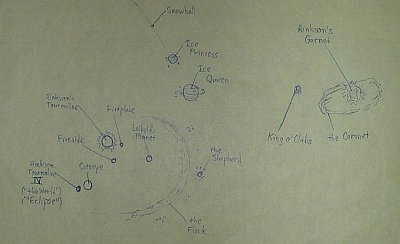
Hinkson's Tourmaline has nine planets in eight planetary orbits, as follows:

1. Fireplace.  Diameter: 2500 mi. Distance from primary: 28,000,000 miles. Period of revolution: 60.3 days. Sidereal period of rotation: 60.3 days. Orbital eccentricity: 0.045. Volume (Earth = 1): 0.03. Mass (Earth = 1): 0.04. Density (g/cc): 7.1. Surface gravity (Earth = 1): 0.41. Albedo: 0.15. Mean subsolar surface temperature: 1340° K. Number of satellites: 0.

This small planet orbits a mean distance of only 28 million miles from its primary, coming at periastron to within 26.74 million miles. Fireplace always keeps the same face turned toward Hinkson's Tourmaline, and temperatures on its sunward side reach upward of 1340° K. (2000° F.) With most of the lighter elements having long since been driven off by solar heat, Fireplace is extraordinarily dense— in fact, it possess a dense but shallow atmosphere, consisting of mercury vapors, and on the dayside, of lead vapors as well. This atmosphere is only about 300 meters deep— thus even steep hills project above the atmosphere. Atmospheric circulation is a simple Hadley cell, with a sharply marked thermocline between the hotter upper atmosphere which moves toward the night side, and the less hot returning lower atmosphere.

2. Fireside.  Diameter: 3800 mi. Distance from primary: 43,000,000 miles. Period of revolution: 114.8 days. Sidereal period of rotation: 114.8 days. Orbital eccentricity: 0.02. Volume (Earth = 1): 0.11. Mass (Earth = 1): 0.11. Density (g/cc): 5.4. Surface gravity (Earth = 1): 0.47. Albedo: 0.06. Mean subsolar surface temperature: 860° K. Number of satellites: 0.

An airless, cratered ball of rock which keeps the same face always turned toward its primary, Fireside resembles the "older" astronomical picture of the planet Mercury in many respects. The dayside approaches 860° K., while the nightside stays near absolute zero.

3. Leibold's Planet.  Diameter: 9100 mi. Distance from primary: 67,000,000 miles. Period of revolution: 223.3 days. Sidereal period of rotation: 8.27 days. Orbital eccentricity: 0.0038. Volume (Earth = 1): 1.51. Mass (Earth = 1): 1.35. Density (g/cc): 4.9. Surface gravity (Earth = 1): 1.02. Albedo: 0.35. Mean subsolar surface temperature: 400° K. Number of satellites: 0.

Somewhat larger than the Earth and rotating slowly due to tidal braking by Hinkson's Tourmaline, Leibold's Planet is named after the ill-fated second Earth expedition to the star system. However, its atmosphere, a thin reducing atmosphere (150 mm Hg. or 0.20 Earth atmospheres) of nitrogen, methane, ammonia, water vapor, and carbon dioxide, does not resemble that of Venus. The reason for this is that Leibold's Planet is large enough to sustain a molten core and plate tectonics, thus most of the free carbon became locked into surface minerals and carried through plate subduction to the asthenosphere or upper mantle of the planet.

4. Catseye/Eclipse  The fourth orbit around Hinkson's Tourmaline is occupied by a double planetary system consisting of two planets, Catseye (diameter 17500 miles) and Eclipse (diameter 7100 miles). The two planets, separated by a mean distance of 35000 miles, rotate about their common center of mass every 13.738 hours. The smaller planet, Eclipse, is relatively earthlike, and habitable for human settlers. More on this double planet system tomorrow.

5. The Shepherd.  Diameter: 4700 mi. Distance from primary: 238,000,000 miles. Period of revolution: 1495 days (4.09 years). Sidereal period of rotation: 23.0 hours. Orbital eccentricity: 0.0095. Volume (Earth = 1): 0.21. Mass (Earth = 1): 0.18. Density (g/cc): 4.6. Surface gravity (Earth = 1): 0.50. Albedo: 0.07. Mean subsolar surface temperature: 190° K. Number of satellites: 23.

As with our system, the system of Hinkson's Tourmaline has an asteroid belt inside the orbit of its first Jovian planet. However, the largest "asteroid" is in this case larger than our planet Mars, a colder version of which it in fact resembles. The planet, dubbed "the Shepherd," superintends the smaller bodies which are naturally enough termed "the Flock." The Shepherd has orbiting itself no less than twenty-three moons; there are also sizeable concentrations at each Trojan point. Moreover, the Shepherd has almost totally cleaned out the resonant gaps among the Flock which correspond to orbits whose period is a rational multiple of the Shepherd's period; the phenomenon is similar to the Kirkwood gaps in our own asteroid belt, but much more pronounced, so that, seen from several astronomical units above the ecliptic, the Flock looks rather like a giant version of the rings of Saturn, but even more striking.

6. Ice Queen.  Diameter: 42000 mi. Distance from primary: 437,000,000 miles. Period of revolution: 10.2 years. Sidereal period of rotation: 14.4 hours. Orbital eccentricity: 0.03. Volume (Earth = 1): 148.7. Mass (Earth = 1): 35.1. Density (g/cc): 1.3. Surface gravity (Earth = 1): 1.25. Albedo: 0.40. Mean subsolar surface temperature: 120° K. Number of satellites: 8.

The first Jovian planet in the system, Ice Queen presents marked atmospheric bands, most colored white or faint grey. The planet possesses a faint ring, and eight known moons, named after the kings and queens of the classical card deck (David, Alexander, Charles, Caesar, Pallas, Argine, Judith, Rachel).

7. Ice Princess.  Diameter: 25000 mi. Distance from primary: 863,000,000 miles. Period of revolution: 28.3 years. Sidereal period of rotation: 18.7 hours. Orbital eccentricity: 0.035. Volume (Earth = 1): 31.4. Mass (Earth = 1): 7.99. Density (g/cc): 1.4. Surface gravity (Earth = 1): 0.80. Albedo: 0.40. Mean subsolar surface temperature: 85° K. Number of satellites: 4.

The small Jovian planet, Ice Princess, resembles its larger neighbor except that its atmospheric bands are less strongly marked. It too has a faint ring system, and four moons, named after the jacks of the card deck (Ogier, Judah Maccabee, La Hire, Hector).

8. Snowball.  Diameter: 1500 mi. Distance from primary: 1,263,000,000 miles. Period of revolution: 48.5 years. Sidereal period of rotation: unknown. Orbital eccentricity: 0.07. Volume (Earth = 1): 0.007. Mass (Earth = 1): 0.001. Density (g/cc): 1.0. Surface gravity (Earth = 1): 0.034. Albedo: 0.20. Mean subsolar surface temperature: 75° K. Number of satellites: 0.

The object named Snowball remains something of an enigma. It seems to be composed largely of ice, frozen methane, and dust and gravel. It would seem to be perhaps a piece of cometary matter, if not for its large size. It has not yet been subjected to individual investigation.

Hinkson's Garnet, at a mean distance of 5.5 billion miles from Hinkson's Tourmaline, is circled by an asteroid belt called the Coronet; and further out, a large, dark, rocky planet called King o' Clubs. These have not yet been examined close up.

There you go, a star system of my own! At one time I calculated this all out in gory detail, though please don't ask my aching skull to revisit those calculations 20 years down the road. You'll notice my star system is in some ways very broadly similar to our own solar system— I never dreamed at that time just how wild and different many of the extrasolar planetary systems we're discovering nowadays would be.

Tomorrow: More on the Catseye/Eclipse double planetary system.

Labels:

Sunday, April 01, 2007

The Manor of Buchhorn: A European Micro-State

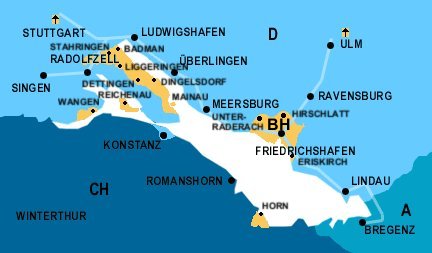
map of lake constance
Fig. 1: Map of Buchhorn and Lake Constance

A "postage stamp" country ruled by a knight who lives in a castle— Buchhorn is so small and fragmented, that it is usually omitted on maps of Europe, and even in surveys of European "micro-states."

The Manor of Buchhorn (German: Rittergut Buchhornes) is indicated in gold on the map above (BH). It consists of two islands and four disconnected enclaves, located around Lake Constance (German: Bodensee), with Germany (D) to the north, Switzerland (CH) to the south, and Austria (A) at the east end of the lake. The climate is mild. The peaks of the Swiss Alps dominate the sky to the south across the water.

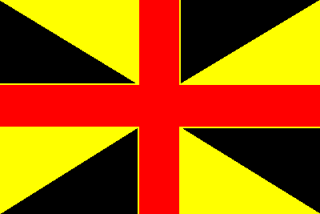
flag of buchhorn
Fig. 2: Flag of Buchhorn

The flag of Buchhorn, known as the Octal Gyron, consists of a red cross on a black and yellow background.

The history of the manor began when a knight of the Order of St. John, returning from the Crusades, was granted by the Holy Roman Emperor the Island of Mainau in Lake Constance. There, in the 13th century, the first knight of the Mainau line built a castle which still stands today.

Intermarriage brought the adjacent coastline, as well as the enclave of Wangen, under the rule of the House of Mainau.

At the time of the Protestant Reformation, the island abbacy of Reichenau also came under the protection of the Ritter von Mainau, the only German Knight of St. John to remain Catholic. It was also in this period that the port city of Friedrichshafen, and the surrounding enclave of Buchhorn, sought the protection of the Ritter and his army.

The Treaty of Westphalia (1648) recognized the sovereignty of the Manor of Buchhorn.

The enclave of Horn was purchased from the Swiss canton of Thurgau in 1786.

Buchhorn was the only one of the German petty states to resist absorption into Bismarck's Germany. It remained neutral in both World Wars. Buchhorn today is known for its manufacture of automotive and aircraft parts, its orchards and vineyards, and its tourist industry. It also has a "pocket navy," the Weissbodenseeflotte, a tourist, commercial, and coast guard fleet which patrols Lake Constance.

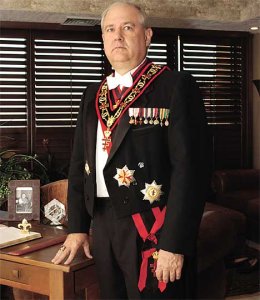
karl adam iv
Fig. 3: Johanniterritter Karl-Adam IV von Mainau

Karl-Adam IV, of the ancient knightly house of Mainau, was created a knight and invested with the Sword of Office in 1980. Since the late 18th century, the Knight of Buchhorn has been created by the Bishop of Constance and the Hospitallers' Grand Prior of Vienna.

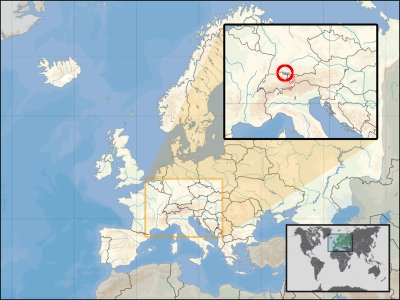
location of buchhorn in europe
Fig. 4: Location of Buchhorn in Europe

Name: The Manor of Buchhorn (German: Rittergut Buchhornes).

Area: 38 square miles.

Population: (2000 census) 74,000.

Capital: Friedrichshafen (pop. 42,000).

Ethnic Groups: German, 100%.

Language: German (official), Swabian German dialect.

Religion: Roman Catholic (official), 93%; Evangelical & Reformed, 6%.

Head of State and Head of Government: Johanniterritter Karl-Adam IV von Mainau, Knight Hospitaller of the Order of St. John of Jerusalem.

Legislature: Diet of 18 members, 6 appointed, 12 elected.

Currency: Thaler (= DM 1.33). 1 Thaler = 100 Rappen.

Labels: ,

Monday, March 06, 2006

The Galaxy in My Mind

Back in my teenage years— 8th grade up through my first year or two in college— I wrote an astonishing pile of science fiction stories. Short stories, novellas, sketches, fragments, background pieces, and half an unfinished novel. They were all set in the same fictional universe, a future history where Man (this was back before "inclusive" language) went forth to conquer and colonize the galaxy. Tons of material, much of it never got written down, and to this day I could lay it forth for you out of my head in mindnumbing detail.

Let's see if I can briefly sketch out this future history...

Man (this was back before "inclusive" language) spread out and began to explore the Solar System by the late 20th & early 21st century. The Moon and Mars were colonized, space-based industry grew up in earth orbit, lunar orbit, at the L5 points, etc. At first freedom flourished on this new frontier. But eventually the economic leverage of space-based industry grew until Earth and its colonies were ruled by an authoritarian military-industrial complex.

Eventually the Moon, Mars, Venus, and Mercury were terraformed. The young heir to a major terraforming corporation led an unsuccessful revolt on Mars; this was the last open rebellion against the regime which ruled over the Solar System.

The moons of the outer planets were settled, but were never economically very profitable. The joker was the Asteroid Belt: vast, widely dispersed, resource-rich, and far too large to be effectively controlled or policed. Earth tried to maintain a grip on the asteroids; but much went on in the Asteroid Belt which was beyond any central control.

At long last, a rebel enclave among the asteroids constructed and dispatched a ship to the Alpha Centauri system. It took the ship many years to travel the four light-years to Alpha Centauri. There Man's first interstellar colony grew in freedom on the habitable planets of Alpha Centauri A, Alpha Centauri B, and Proxima Centauri.

Several centuries thereafter, ships from Earth arrived in the Alpha Centauri system, leading to the outbreak of the First Interstellar War, which continued fitfully for a couple of centuries. Not much you can do when it takes years to reach your enemy's territory. A peace was concluded, but it didn't hold, and the Second Interstellar War continued for another several hundred years. Then a hyperlight drive was discovered, cutting travel time between Earth and Alpha Centauri from years to mere days: in short order, the two star systems bombed each other back to the stone age.

Several thousand years later, Alpha Centauri climbed back up from barbarism to civilization, and back to the stars. They were equipped with the old hyperlight drive, which they had retrieved from the ancient wreckage of war: they learned how to duplicate and use the hyperlight tesseracts, but understood their inner workings no better than a headhunter understands an airplane engine. So Man went forth to his second and greater colonization of the stars.

Humans spread out across hundreds of light-years, colonizing thousands of worlds. The Hermetics grew up as interstellar traders, something like the Free Traders in Heinlein's Citizen of the Galaxy, and my Hermetic language became a lingua franca among the stars. For some reason, the interstellar economic system in my stories was neither capitalism nor socialism, but mercantilism. Many of the little craft items I turned out in those years were marked in Hermetic "Zinir," "For Export."

More than 100 light-years from home Men encountered the Camels, a race of intelligent creatures from the Gamma Geminorum system which had themselves been colonizing the stars for several millennia. Imagine talking deer standing upright on their hind legs. Men and Camels were vastly different physically, and they also had certain psychological differences, but overall they had far more in commmon than most alien races, and they hit it off well together. Men and Camels, for all their differences, eventually became culturally one race.

There were other alien races that appeared in my stories. The Esloniki were a more or less humanoid race, much engrossed with board games and card games. (!!!) The Esloniki (Slaun Ki, "People of the Game") were also masters of a surreal martial art known as the feng cra, pirouetting through the air, balancing on the edge of a knife blade, punching through stone without effort, walking through walls— something like in The Matrix, you know. The Uranai, inhabitants of smaller and colder gas giants like Uranus and Neptune, had been around in the galaxy far longer than we had; they had five sexes, and lived for tens of thousands of years. The Proyng, a silver-based life form from the intensely hot planet of a blue supergiant star, were (as in C.S. Lewis's Perelandra) unfallen.

Human and Camel settlement came eventually to extend out to stars more than 6000 light years from Earth. Then a vast war broke out, between two human interstellar empires, the Cliton Confederation and Wolf 851. The Clitonian-Wolfite War continued for 3000 years, until finally a Clitonian physicist, Robert Ansel, unraveled the how and the why of the hyperlight tesseract, which yielded not only an improved hyperlight drive, but also weapons along the lines of the Star Wars Imperial Death Star.

In fact, Ansel had discovered far more than this: his "Unified Grid Theory" was something like a cross between a Unified Field Theory and the Kabbalah. He was called in to be examined before a session of the Clitonian High Council. The session dissolved in confusion when Ansel testified: "I am not saying that there are less than a dozen persons in the galaxy who understand my theory. I am saying that there are less than a dozen persons in the galaxy who are capable of understanding my theory. You cannot teach the calculus to a chimpanzee."

It later came out that Ansel had metaphysically "sealed" some of the more deadly portions of his Grid Theory, and had rendered himself metaphysically immune to having these portions of the theory extracted from him, even under torture. Meanwhile, the Clitonian military took those portions of Ansel's new technology which they already had in their possession, and reduced the Wolfite homeworlds to pea gravel. As an afterthought, they also slaughtered the Esloniki, for no apparent reason. The handful of surviving Esloniki were consigned to a reservation, where they played games, went into a moping decline, and went extinct within a few generations.

(These stories reflect the rather acid view of the human race which I had as a teenager... as if you hadn't already guessed?)

And then a future history which stretched on and on... after a long span of millennia, Men and Camels achieved the Zenith of the Sentients (Mna Thijad Pmopaninl), where they walked among the stars physically like ghosts of light, with vast powers, each individual capable of singlehandedly remaking the face of an entire world in beauty.

But then came an invading alien race, known only as the Enemy— think of intelligent cephalopods, octopuses, devious, nihilistic, and utterly without mercy. And Men and Camels gathered for the Council of Tau Ceti, where they debated and wrung their hands like relativist postmodern university professors, agonizing over whether they had any right to prevent the Enemy from exterminating them. The Council's final decision: We have no right to defend ourselves, we have no right to survive; let the Enemy come and wipe us out, for that is his truth, and we have no right to oppose it. (My high school English teacher hated this story, because she felt it impugned her sacred relativism. Wonder what she must think in today's post-9/11 world?)

Men and Camels were stripped of their powers, and became fugitive, hunted creatures, fleeing among the stars. Such was the Coming of the Darkness. A few, like the Camels of the Blue Nebula, or the Raldic Empire under Catherine the Wise, fought back against the Enemy, or preserved fragments of learning and culture through those Dark Ages. A few, like the giant redskinned human Tlanti, fled thousands of light-years out along our spiral arm of the galaxy, and settled on worlds far remote from the conflict.

But darkness held sway for long ages, until a warrior-king returned from the Galactic Rim, bringing with him a fleet of interstellar battleships. For from among the Tlanti arose a sometime warrior, a sometime interstellar merchant, a ruler among men, who declared war upon the Enemy, a war for the liberation of the Galaxy; and he came proclaiming: "Behold, I am Simon Athelstan, who is Emperor of the Seven Stars, and Lord of the Princes of the Vanmoor; let the record of my victories be set forth among every people in every star system, in Tlantic and in Hermetic and in Alhennan, on plates of violetized steel..."

Oh, and in these science-fiction stories, people engaged in hand-to-hand combat with swords. Also with "nimbic torches," a handheld device which generated an energy arc that could slice right through solid objects. Rather like an energy-field chainsaw. Or something like a light saber.

I was writing these stories, an endless pile of them, in my teenage years, late 60s through mid 70s. So you can see why I was just blown away when I walked into a movie theater one day in 1977 and saw a movie called Star Wars...

Labels: ,