Wednesday, October 10, 2007

What Did the High Step Say to the Low Step?

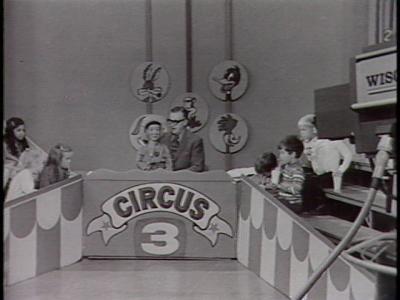
circus 3
When I was five years old, I came up with a joke which I thought was just hilarious:
Q: What did the high step say to the low step?

A: "You're too low to step on!"
I dunno, demented as I am, I still think it's funny. You know? They're both steps! They're both made to be stepped on! Though it's one of those things, either you get it, or else you don't.

Anyhow, for my sixth birthday I was going to be a guest on a local TV show called Circus 3. A ventriloquist named Howie Olson, a dummy called Cowboy Eddie, a bunch of kids sitting in the peanut gallery on little bleachers off to the side, and some chit chat in between airing various cartoons. I insisted to my folks that I was going to tell that joke live on the show. And my parents, watching from the next room through glass, were terrified that I was actually going to find some way to break in and tell that joke on the air...

Labels:

Monday, September 17, 2007

Battlezone, Beer, and FORTRAN

I've been thinking back to those days, 1979 or 1980, when my routine ran like this: I'd be out at the library of a weeknight, studying till ten or eleven in the evening, working on some proofs in Fourier analysis or algebraic topology or partial differential equations. Writing on pads of yellow legal paper, pushing the proof through on this front or that, hit a roadblock, puzzle over it sometimes for an hour or more and then suddenly the next step to take would dawn on me in a flash. Maybe work a while then, grading quizzes or homework for a calculus discussion section I was teaching.

Then, maybe 11 PM or so, I'd sling my backpack over my shoulder and head down State Street. Just off the campus of the University of Wisconsin-Madison. Head down to State Street Brats, duck in the door, pick up a copy of the Daily Cardinal or the Badger Herald if one was to be had. Get a beer, tap beer was a quarter back in those days. Retire to a booth in a semi-unlit corner.

Or I might also play a game of Battlezone, they had Battlezone at State Street Brats: two games for a quarter, this was one of the very first primitive video games, just then replacing the old mechanical pinball machines. Battlezone, crude 3D tanks appear in green wireframe outline on a monochrome monitor, sound of tank engines, crude 3D wireframe boulders here and there, crude 3D wireframe mountains in the distance. Maneuvering in a virtual world, I take aim and shoot at enemy tanks, blasting them before they can blast me.

Most of the tanks are broad and squat. Once in a while there's a thin, sleek 3D green wireframe tank, and those are quicker, deadlier. But deadliest of all are the guided missiles (3D green wireframe) that come buzzing toward you from over the mountains, buzzing with a noise like an old prop plane engine. You've got to shoot just right to hit those, or else the scene will be covered with crude green wireframe cracks running all over the screen, GAME OVER.

Or there was an Asteroids game, equally crude monochrome wireframe asteroids. I think this was back before PacMan or Centipede.

Afterwards it was back over a block or two to the fourth-floor apartment, up above the KK (Kollege Klub), which I shared with my brother. The little U-shaped efficiency apartment, over in one corner sat my old early 60's wood-cabinet stereo which played vinyl records which were, you know, all we had in those days, nobody had ever heard of CDs. It was a different world, a world of President Carter and "malaise" and the Ayatollah Khomeini, Newsweek written at a reading level several grade levels higher than it is today.

Next morning I'd teach that calculus discussion section, then over to the computer science building where I'd finish writing a program in FORTRAN, then type it up on punched cards at a keypunch machine. Or if I had a spare moment, I might read Athanasius or Justin Martyr, volumes checked out of the University library, which is how I eventually ended up where I am today; but that's another story.

I think back to that world of almost 30 years ago, and how different a world it was, and how different a person I was. Give me that long again, and I'll be 80, white-haired, and retired. It makes a person think.

Labels:

Friday, June 22, 2007

June 22, 1974

Odd how memory works. I can remember exactly what I was doing 33 years ago today, June 22, 1974. I had just graduated from high school, and I was about to turn 18. I spent the day working out on the back porch on a homemade mah jongg set. Then I stayed up late into the night, and watched some Charlie Chan movie on TV into the wee hours of the morning. Finally, getting on toward dawn, I wandered out to the other end of town, up by the school, up along the highway, where semi trucks barrelled by down Highway 51 in the gathering light of sunrise. Then home and, after 24 hours awake, I collapsed into bed.

Labels:

Friday, June 01, 2007

How the Silver Screen Inside My Skull Combusted in the Outer World

One of the gentle amusements of my middle age has been to see how much the popular culture around us is coming to resemble the phantasmagoria that used to whirl round and round inside my own skull 30 and 40 years ago. Back in those days, there was little or nothing in the culture at large that answered to the Roman-candle contents of my incandescent imagination. But something has happened since then. There has been an epochal shift. And now when I look around me, it seems in recent years more and more as though the shadow-show that flickered inside my youthful skull has emerged and combusted in the world around us.

I remember when I was a kid, I loved cartoons. Now, back in those days "cartoons" meant Yogi Bear and Huckleberry Hound and Bugs Bunny and whatnot. I loved those cartoons. I still do. But inside my ten-year-old head was a vision of cartoons where epic battles raged. Cosmic forces of evil. Mighty heroes. Strange powers. Energy blasts, explosions! The fate of the world hanging in the balance!

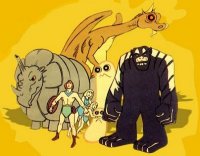
herculoids
Only back in those days, there weren't such cartoons. "Cartoons" pretty much meant Yogi Bear stealing another picnic basket. Well, actually there was one cartoon on TV that tended in the direction of what I would've preferred: The Herculoids was a wondrously incorrect cartoon about these characters defending their planet against alien invaders. Wham! Zap! Kaboom! My favorite Herculoid was this critter like a ten-legged rhinoceros that fired exploding rocks out of its horn.

I wished they would've had a lot more cartoons like that on. Only they didn't. Back in those days I don't know who else besides myself would've watched the kind of cartoons I really wanted to see. The kind of cartoons that were whirling round and round inside of my skull.

eva unit 01
Because the kind of cartoons I was envisioning back then— the kind of cartoons that were precisely nowhere to be found in the world outside my own skull— were a lot more like today's Japanese anime. Believe me, when I was twelve I would've gone crazy over something like the Japanese anime series Neon Genesis Evangelion.

eva unit 01
Giant robots— the Evangelions— fighting creatures known as the Angels which are attacking Tokyo-3 in the year 2015. Fifteen years after a catastrophe known as the Second Impact, which wiped out half the human race. Only a few select youth are capable of synchronizing with the Evas and piloting "mankind's ultimate fighting machine" in the battle against the Angels.

eva unit 01
Commander Ikari: "Reclassify Evangelion Unit 03 as the Thirteenth Angel! All units, the target must be destroyed!" —Shinji Ikari, piloting Eva Unit 01: "But father, there's a pilot in that Eva, a kid just like myself!" Oh, you can't imagine how I would've loved watching Neon Genesis Evangelion back circa 1968, when I was 12 years old! If, that is, I'd ever dreamed outside of my own imagination that works like that might even exist!

And comic books. Comic books meant Donald Duck, or Archie and Jughead. Which, don't get me wrong, I enjoyed and still enjoy such comics. But I preferred superhero comics. Yeah, DC, that was okay: Superman and Batman; or my own DC favorites, Green Lantern and the Flash. But what I really loved were Marvel Comics. Spider-Man. The Incredible Hulk. The Avengers. Or my very favorite comic from Marvel was the Fantastic Four.

What I loved about the Fantastic Four was not only Jack Kirby's brilliant, free-flowing artwork, which made DC's artwork look like stodgy, crisp banknote-engraving by comparison. Not only the free, loose, wide-open "fate of the world hanging in the balance" stuff, Johnny Storm going up in a hopeless last-ditch battle against the cosmic might of Galactus: "All right, if this is going to be Earth's last stand, let's do it up right! FLAME ON!" No, what I also loved about the Fantastic Four was the maudlin soap opera side of it, super-heroes going all emotional and angst-ridden and squabbling like a dysfunctional family.

I suppose these comics must've been selling out there to someone besides myself. But I grew up in a world where really nobody but myself was into comics. Nobody but myself was into the Fantastic Four or Spider-Man. My own folks were cool with comics, but I knew a lot of adults whose attitude was, child, don't touch those eeeeevil publications, they'll rot your mind out like a four-color computer virus.

Little could I have imagined back then that in my adult years, by the 1980s and on into the 90s, I'd be seeing comic books like Nexus, or Matt Wagner's Mage, or Alan Moore's stunning Miracleman. Little would I have dreamed that what once cycled round and round in my own mind would one day combust in the theaters in the form of Spider-Man or the Fantastic Four movies. Movies with special effects like in those days were to be seen nowhere outside of my own skull.

Likewise science fiction. I used to read and love science fiction books. By the time I was in junior high and high school, I was already amassing my own library of science fiction paperbacks. Robert Heinlein. Isaac Asimov. Arthur C. Clarke. John Brunner. James Blish. Clifford Simak. "Doc" Smith. Alfred Bester. Larry Niven. Poul Anderson. Ray Bradbury. Ursula Le Guin. Jack Vance. Roger Zelazny. Frank Herbert. Theodore Sturgeon. Problem was, back in those days, 60s and early 70s, science fiction was even more of a marginalized, ghettoized, disreputable genre than comic books were. I mean, science fiction in those days was a disreputable "pulp" genre, rather like lurid true crime tabloids.

Never would I have dreamed back then that one day science fiction would enter the cultural mainstream. It started in the late 70s, with the appearance of the first Star Wars movie. Yet long before that, my mind would've been ready. I was already long writing my own science fiction stories with strangely Star-Wars-like elements in them. Yes, my stories included a handheld energy-arc-wielding device called a nimbic torch years before I ever heard of light sabers.

And from the time I first read Robert Heinlein's "They," my efflorescent mind was primed for the likes of The Matrix. Yes, The Matrix. Let's not get into an alien race called the Esloniki in my stories, who practiced a surreal martial art called the feng cra, leaping and pirouetting in slow-motion defiance of gravity, chopping effortlessly through wood and steel and concrete, walking through walls, stopping bullets, balancing on a sword's razor edge. It was all there in my head circa 1972.

Humor. I remember living in a world where humor meant Red Skelton or Carol Burnett or Jackie Gleason, and nothing more. I mean, talk about stiff! Talk about embalmed! Then I went away to college, and stumbled across Monty Python, which approximated the style of humor which had already been whirling around in my gourd without proximate outward analog. And we live today in a world in which Monty-Pythonesque humor has become mainstream.

Music. Well, I first came to an awareness of myself and the world around me in the late 60s. Here the driving beat of rock music got through to many of my friends as it got through to me. I was not so alone in my musical tastes as I was in so many other areas. But I remember a time when rock was truly subversive, truly countercultural, truly outside the "grown-up" mainstream of our culture. It belonged to my generation, and not to as many of us as you might imagine looking back. I remember when I first realized that rock was entering the mainstream: it was 1976, and they were playing rock music during halftime at a football game on TV— which, at the time, stunned me. Yes, we live in a world today where rock is part of the mainstream culture. Incredible as that would've seemed to me back in the late 60s.

So many of my younger interests were odd, obscure, hard to find anything on them back in those days. Shogi or Japanese chess. Postage stamp countries like Liechtenstein or Andorra. Synaesthesia. The likelihood of planets outside our solar system. Self-constructed languages, such as my own Hermetic language. Shortwave radio and radio DXing.

Something has happened in the culture at large in the years and decades since then. The old culture, the culture of Yogi Bear and Carol Burnett, got some of the starch knocked out of it. And a hundred flowers have opened up and bloomed, in living technicolor. More variety. More breadth and depth. Much richer detail available on almost any odd topic you care to name. On a cultural level, on the simple level of images that flit through the mind's eye, the doors of perception have been opened wide.

The Internet has facilitated this process, and enabled people of like interests to connect. But the blooming I've witnessed in my time was already under way, 15 and 20 years ago, back before Internet access became widespread.

And the odd thing is, those images, those hundred flowers, were already flitting through my mind's eye 30 and 40 years ago. The older I get, the more our popular culture approximates to the lifelong shadow-show within my own mind.

Labels: ,

Tuesday, March 13, 2007

TV Commercial, Circa 1960

cities service logo
I remember this ancient TV commercial, I must have been only 3 or 4 or 5 when it was on. It was on Channel 3 from Madison— somehow, I remember seeing it right after we got home from visiting my grandparents one evening, with the ceiling light on (as it rarely was) in our living room.
It's service
It's service
It's service
It's Cities Service

It's service
It's service
It's service
It's Cities Service

Call EMpire-5 4639
Right now!
On the screen: a still shot of a fabric background, a trefoil "Cities Service" logo, and some writing along the side. I remember Channel 3 sometimes used to air "budget" TV commercials in this still-shot fabric-background format.

Labels:

Wednesday, February 21, 2007

A Late 80s Style That Wasn't In for Long

Am I the only person who remembers this? There was a style for the interior of public places which was really "in," and really seemed to be spreading and catching on, for a brief while back in the late 80s. I'm talking like 1987 or 1988.

I first noticed it in a shopping mall I frequented. Then you'd see it around in libraries or other places that had just been remodeled. Heavy use of certain colors: salmon and sea green. Lots of ornate brass, elaborate light fixtures with spherical or bowl-like glass shades, brass chandeliers, brass wall sconces, all in bright, bright shiny brass. Decorative wooden or plaster molding. Colored wood or blonde wood. Overall a rather geometric effect, something like Art Deco but all in off-color metrosexual pastels.

Back in 1987 or 1988 this style was spreading. I mean, it was appearing all over. It looked like it was going to be the Next Big Thing. Then within just a year or two it fizzled out, and fell completely out of style. Though to this day once in a while I'll run across a restaurant or a library reading room, and I'll think to myself, this place must've been redecorated in the late 80s.

Labels:

Friday, February 09, 2007

Number Lists

Back about in fourth grade my friend Chuck and I got the bright idea of writing up number lists. I don't know where we got this idea from, but somehow we found it fascinating. The idea was, you would simply take pen and paper, and start writing out a list of numbers. Starting with 1, and going up. Certain key numbers would be circled, or underlined, or have a square or pentagon or whatever drawn around them.

And we would just keep going like this, page after page. I think I got up above 5000. One time (yes, we did this on more than one occasion) Chuck got up over 25000. I kid you not.

1, 2, 3, 4, 5, 6, 7, 8, 9, 10, 11, 12, 13, 14, 15, 16, 17, 18, 19, 20, 21, 22, 23, 24, 25, 26, 27, 28, 29, 30, 31, 32, 33, 34, 35, 36, 37, 38, 39, 40, 41, 42, 43, 44, 45, 46, 47, 48, 49, 50, 51, 52, 53, 54, 55, 56, 57, 58, 59, 60, 61, 62, 63, 64, 65, 66, 67, 68, 69, 70, 71, 72, 73, 74, 75, 76, 77, 78, 79, 80, 81, 82, 83, 84, 85, 86, 87, 88, 89, 90, 91, 92, 93, 94, 95, 96, 97, 98, 99, 100, 101, 102, 103, 104, 105, 106, 107, 108, 109, 110, 111, 112, 113, 114, 115, 116, 117, 118, 119, 120, 121, 122, 123, 124, 125, 126, 127, 128, 129, 130, 131, 132, 133, 134, 135, 136, 137, 138, 139, 140, 141, 142, 143, 144, 145, 146, 147, 148, 149, 150, 151, 152, 153, 154, 155, 156, 157, 158, 159, 160, 161, 162, 163, 164, 165, 166, 167, 168, 169, 170, 171, 172, 173, 174, 175, 176, 177, 178, 179, 180, 181, 182, 183, 184, 185, 186, 187, 188, 189, 190, 191, 192, 193, 194, 195, 196, 197, 198, 199, 200, 201, 202, 203, 204, 205, 206, 207, 208, 209, 210, 211, 212, 213, 214, 215, 216, 217, 218, 219, 220, 221, 222, 223, 224, 225, 226, 227, 228, 229, 230, 231, 232, 233, 234, 235, 236, 237, 238, 239, 240, 241, 242, 243, 244, 245, 246, 247, 248, 249, 250, 251, 252, 253, 254, 255, 256, 257, 258, 259, 260, 261, 262, 263, 264, 265, 266, 267, 268, 269, 270, 271, 272, 273, 274, 275, 276, 277, 278, 279, 280, 281, 282, 283, 284, 285, 286, 287, 288, 289, 290, 291, 292, 293, 294, 295, 296, 297, 298, 299, 300, 301, 302, 303, 304, 305, 306, 307, 308, 309, 310, 311, 312, 313, 314, 315, 316, 317, 318, 319, 320, 321, 322, 323, 324, 325, 326, 327, 328, 329, 330, 331, 332, 333, 334, 335, 336, 337, 338, 339, 340, 341, 342, 343, 344, 345, 346, 347, 348, 349, 350, 351, 352, 353, 354, 355, 356, 357, 358, 359, 360, 361, 362, 363, 364, 365, 366, 367, 368, 369, 370, 371, 372, 373, 374, 375, 376, 377, 378, 379, 380, 381, 382, 383, 384, 385, 386, 387, 388, 389, 390, 391, 392, 393, 394, 395, 396, 397, 398, 399, 400...

Labels:

Monday, January 29, 2007

Buffalo Nickels in Your Change

It was about 1967 that I received two buffalo nickels in change at Clark's neighborhood grocery store. Two buffalo nickels. Around that same time, a friend of mine received an Indian head penny in change.

I remember how we routinely used to get old coins in change, back in those days when coins were worth something and we used to get our groceries at neighborhood grocery stores. Standing Liberty quarters. Ben Franklin half dollars. Walking Liberty half dollars. Mercury dimes. All these and more were not uncommon.

As a kid I had a penny collection. I didn't have every Lincoln penny issued, I was missing some of the rarer ones, but I had most of them, going all the way back to 1909, and including a 1909 VDB penny. And I built up my penny collection entirely by watching the pennies that turned up in my change.

I don't know just when older coins began disappearing from circulation. The abandonment of silver coinage and the rising price of silver certainly had something to do with it, though I remember silver coins didn't disappear from circulation overnight. I also thought coin collectors had something to do with it, as witness the gradual vanishing of wheat pennies from circulation.

I have a wooden box which has stood on top of my dresser ever since I picked that box up at a garage sale in the summer of 1982. For many years my pocket change tended to gravitate toward that box, where it sat forever until several years ago I finally went through and sorted it out. I found in this pocket change— dating back to 1982, mind you— several silver Roosevelt dimes, several dozen wheat pennies, and a number of steel pennies. I also found three buffalo nickels, no idea where that third one came from. All of which would indicate that, as recently as 25 years ago, there were still occasional silver coins in circulation, plus various other older coins including older pennies.

I won't say you'll never see a wheat penny in change nowadays, but I can't remember the last time I received one. It's been years. Today's coins just aren't the same, to say nothing of how they aren't worth a plumb nickel anymore. Assorted state quarters, most of them lackluster and obviously designed by committee. The occasional "fantasy nickel," with an odd three-quarter profile of Tom Jeff, or a Kon-Tiki raft on the back, or whatever. Imagine getting a buffalo nickel in change today. It just wouldn't happen.

Labels:

Friday, December 22, 2006

These Last Days Before Christmas

point blanket capote
It's always seemed to me that, these last few days before Christmas, time slows down and assumes a different pace. Things move as if in slow motion. The world pauses. Christmas vacation has begun.

When I was a kid we would go out and ride our sleds down the hill in our back yard. My sled had originally belonged to my Grandfather, and it dated back to before 1900. In those days we were on easy terms with the past.

We were waiting for Christmas. Waiting for Christmas presents. One year I got Mike Hazard, Secret Agent. Another year I got Major Matt Mason and his Space Station. Oddly enough, I never believed in Santa Claus. We weren't brought up that way.

point blanket capote
The Christmas tree was already beginning by now to shed needles all over the living room rug. In those days we had a real Christmas tree. There were some bulbs on the Christmas tree with fluid-filled glass columns, bubbles would bubble up in the fluid when the bulb was on and it got hot: these dated back to the 1930s, when my Dad was a kid. There were ornaments on the tree, such as a bugle, or a paper castle, which dated back to the 1890s, when my Grandfather was a kid.

My brother and I used to play a game called Journey to Bethlehem. I think it had originally been a greeting card. It folded out into a board game. The idea was, we were journeying to Bethlehem to see baby Jesus. You would draw a card and move to the next square with that symbol on it. The symbols were: blue angel, green shepherd, yellow star, red cup. I'm not quite sure what the cups had to do with it all. Some squares were like "move back two squares" or "lose one turn." This game was always a very special part of Christmas time for me.

In later years, I remember the time when I was living in North Carolina, 1100 miles from family and unable to afford the trip to see them for Christmas. And in these last few days before Christmas, I went out and got myself a gyroscope and a deck of Rook cards to amuse myself with, there alone in my apartment.

point blanket capote
Now this year, once again, time slows down in these last few days before Christmas. I have to pull my sermon together for Sunday, but I don't have much else that I have to do these next few days. I'll have a busy Sunday, and then Christmas morning, Monday, I'll be heading over into Wisconsin to visit my folks for several days.

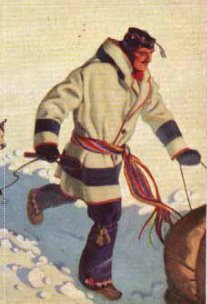
My insane Christmas project this year involves turning out a wool coat to my own specifications. I got a Witney point blanket, and a couple of patterns which I've been mixing and recombining, from a historical reenactors' outfit. Old fashioned buttons made of horn from another outfit. And llama braid for edging from yet another outfit. All bought online. I've talked my Mom into doing the sewing while I'm over there, and the result ought to be a very usable winter coat, also a reasonably historically correct simulacrum of the coats, or capotes, made from wool point blankets and worn by Indians, French voyageurs, and whatnot, back in the old days up in Canada.

point blanket capote
Also, there's no snow in the forecast. Looks as though, for the first time in many years, we won't be having a white Christmas. Hunh.

Labels: ,

Monday, December 18, 2006

When Your Car Is About to Float Out on the Tide Toward Japan

This would've been February 1984. I was living at that time in Washington State, up in the Cascade Mountains. Not far off the Columbia River. About an hour upriver from Portland, Oregon.

Anyhow, one day in February, on my day off, I decided to head down to the coast for the day. I forget if it was a two and a half, three hour drive. Drove down the Washington side of the river, Highway 14. Through Vancouver, USA. Through Longview. And across southwestern Washington, now in terra incognita. I had never been to the Pacific coast before, but I knew I was getting close when I saw an old boat, a seagoing boat, lying abandoned in someone's back yard.

Got to southwesternmost Washington, and discovered that it's a peninsula. The Peninsula runs north and south, maybe 15 or 20 miles long, and no more than a mile or two wide, its western edge facing the Pacific Ocean.

Lighthouses. Towns. I drove up and down the Peninsula. Stopped off at a restaurant for lunch, wonderful home cooking, giant juicy hamburgers with a ton of fries, and home-cooked green beans just right, and they had on display inside a glass case a curiosity, a small mummified human head joined seamlessly onto a small alligator's body, so flawless you couldn't even see how it was done, it looked just like real, and you could put coins in a machine, and then put a penny in the slot, and it would take your penny and roll it out long and return it to you, a long penny with a picture of the Alligator Man stamped on the back.

Driving up the street, turn left, now I was on a road which led down to the beach. At road's end, there I sat, in my old muscle car, a bright red 1970 Torino with a 351 Cleveland V8 under the hood. I saw other cars and trucks driving on the sand, driving up and down the beach. Thought I'd give it a try myself.

I started out beyond the pavement, onto the sand, slow and easy. Suddenly I realized I was moving more and more slowly, slow, slowwww... Now I wasn't moving at all. My foot was on the pedal, my rear wheeels were still turning, but I wasn't moving at all. I stepped heavier on the gas— well, that was a mistake. Now wheels turning, no forward motion at all.

I cut the engine, got out and checked. Damn! My rear wheels were sunk into the sand, all the way up to the axle!

My Torino wasn't about to go anywhere. I turned my head and looked west. There the tide was coming in, surf crashing and breaking on the sand, not twenty yards from my front bumper. I had visions of the tide coming in, further and further, and then going out, carrying my car with it. I had lunatic visions of my Torino being carried right out on the tide, toward Japan.

I started trudging back up the street into town. Up this street several blocks, I had noticed, was a service station. Have to get a tow truck. Have them pull my car out of the sand. Greenhorn visitors like me, this must happen all the time around here...

As I walked up the street, I passed a young woman who was sitting there in an old Volkswagen Beetle. She was reading a book, and a big hound dog was sitting there in the seat beside her.

Walking further, now the service station was in sight. And all of a sudden a Volkswagen pulled up beside me from behind. The gal called to me out the window, "Hey, is your car stuck down there on the beach?"

I said yes, sunk up to its rear axles in the sand.

She said, "Jump in." I got into her Volkswagen, she did a U-turn, and we rolled back down the street to the beach, where my Torino was looking rather forlorn.

We got out to inspect. Just so happens right then her boyfriend came tooling down the beach in his pickup truck. You know, the type with big oversized monster tires. He hooked his truck onto my front bumper, and towed me up and free from the sand trap. He also explained to me how to drive on the beach without sinking into the sand— a practical detail which I have since forgotten.

At any rate, after thanking this couple for their help, I got into my Torino, and went driving up and down the beach. Right alongside the Pacific Ocean. No longer did I fear my car being swept out to sea, and floating like a piece of bobbing cork until it washed up, a seaweed-festooned piece of flotsam, on the coast of Japan.

Labels:

Monday, October 30, 2006

Of Church Keys, Bottle Openers, and Change on an Everyday Level

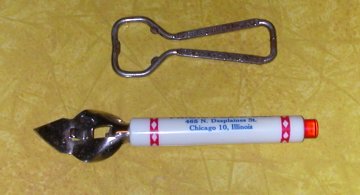
openers
Dean Esmay has an interesting post dealing, among other things, with church keys and pop tabs. Yes, I remember, back when I was a kid, pop cans and beer cans that required an opener. Later I remember detachable pop tabs on beer cans, well into my college years. I remember people making long chains of pop tabs; though, no, I was never inclined to drop the tab into the can. Especially not before I took a drink from it.

Somehow I've never gotten the hang of twist-off bottle caps. To this day, I always use a bottle opener on bottle caps. Though the bottle opener I use is rather ancient, translucent red tip, "Chicago 10, Illinois."

(The other opener in the picture reads, "People's Brewing Co., Oshkosh, Wis.")

Seems to me that changes like these make much more of an impact on people's lives on an everyday level, than the technological changes which are undeniably there, but often more evident to the geek or number cruncher than on any human level.

I grew up with TV. When I was a little kid, television as a medium was scarcely older than today's World Wide Web. And here's the thing: I grew up with a black & white TV in the house. When I was in college, I bought a small 12-inch black & white portable, which for many years was the only TV I had. I never owned a color TV in my life until 7 years ago— yes, not until October 1999. And I can tell you, whatever neat features my new color TV had— on-screen menu, remote control— none of it was as impressive, on a human scale, as the mere fact that the TV was color instead of B&W.

For that matter, my folks grew up in a world without TV. I suspect no changes in TV over the years are anywhere near as radical as the difference between a world with TV, and a world without TV. Yet 50 and 60 years on, we become inured to this difference, and mesmerized instead by those technical differences which can be quantified and measured— differences which pale, on any human scale, in comparison with the difference between color and black & white, or between TV and no TV.

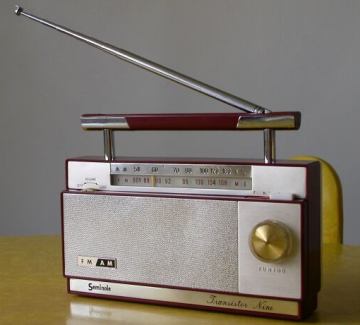
radio
My parents grew up with radio. But my grandparents grew up in a world without radio. I grew up in a world where radios were commonplace, and AM radio was still the "workhorse" of radio broadcasting. I remember back before AM had become primarily the domain of talk radio and sports radio. I remember big-city radio stations which provided just about every kind of radio programming you can imagine, from news to music to sports to radio programs.

In 1963 or 1964 I remember my aunt got a small table radio which had both AM and FM on it. This was the first time I had ever seen a radio which received FM. I was 7 or 8 years old. Yes, FM had been around for some time by then. But it had not yet gained preeminence. Much of the music was still on AM. I remember in the late 60s— and by this time I myself had a radio with FM on it— a lot of the rock music I listened to, I listened to on AM stations. WLS 890 out of Chicago was tremendously popular with some of my classmates, as a rock station.

Today I have radios with all sorts of high-tech features on them, digital tuning, keypad to punch in frequencies, memory chips which will store hundreds of radio frequencies. But on a human scale, the difference between then and now is much more aptly summed up in the changing ratio between AM and FM then, and AM and FM now.

I remember when I was about 10— we're talking 1966 here— we first got to use magic markers in art class. Magic markers in those days had an overpowering odor to them, and they dried out quickly if they weren't kept capped. You weren't supposed to smell of them, something about getting high and brain damage, that may have been an urban legend, I don't know. But they sure did smell. And they were also a big change compared to Crayola crayons.

Then, within a couple of years, when I was in junior high, the first felt-tipped pens came out. Sort of like a magic marker, but a lot thinner. I remember the problem with those early felt-tipped pens was that the point would go all mushy and out of shape after a while. It was several years before that problem was solved, and you had points that would hold their shape. Rollerball pens, of course, were still many years away.

Things like these make a tremendous difference in everyday life, from any human perspective. Yet I suspect the difference made by magic markers and felt tipped pens might slide clear by someone who only was looking at change from a purely quantitative, measurable, number-crunching-oriented angle.

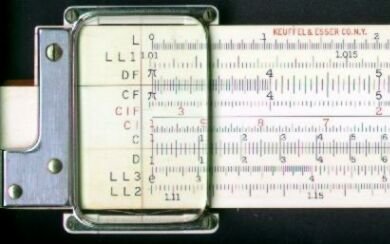
slide rule
Another huge change, which this time might register on the quantitatively-tunnel-visioned, since it has to do with numbers and mathematics: when I was in high school, in the early 70s, we still learned in math how to use a slide rule. I got three slide rules when I was in high school, still have two of them today. When I was about a junior in high school, I also got one of the earliest calculators which could be had for less than $100. Six digits, no decimal point, no memories. Of course, within just a couple of years, calculators had put the slide rule manufacturers out of business.

My brother relates that when he was in high school, mid to late 70s, they were still teaching how to use slide rules. Odd, as by that time slide rules were no longer being made.

Calculators have had a tremendous impact on how people do arithmetic, or rather on how people are no longer able to do arithmetic without punching away at those buttons. It's a tremendously different process from math with a slide rule, or math with pencil and paper. I still have a slide rule sitting on my desk, and I often use it in preference to a calculator. The slide rule, like the light saber, is "an elegant weapon from a more civilized time." Which makes me the last of the Jedi.

Phones. When I was very young, the phone in our house didn't even have a dial on it. You picked it up, and told the operator which number you wanted to call. Then, the rest of the years I was growing up, we had a rotary-dial phone. I forget when phones went to touch tone— doesn't seem I had one, at least, until the late 80s. None of which made as big a difference as the advent of cell phones. In this case, there is a positive correlation between technological change and change on a human scale.

But not always. Sometimes it's the lesser technological changes that make a bigger human difference. And even with phones, I wonder whether any change over the years really compares with the difference between phones and no phones. I've heard anecdotes about businessmen, as late as 1930, who categorically refused to take business calls— let some flunky deal with it instead!— because they'd never used telephones, when they first started out in business back in the days of gaslights and President Benjamin Harrison.

Sort of like the way some people feel today about computers.

Labels:

Saturday, September 02, 2006

8:30 When the Stars Come Out

When my brother and I were kids, we had a routine about an extra minute that was secretly added to every day. Between 8:30 PM and 8:31 PM was an extra minute which we called "8:30 when the stars come out."

People never knew about this extra minute, because the entire world froze for those 60 seconds.

Across the street from our house was a huge lawn which sloped up to a gigantic old building at the top of the hill, a building known as the Academy Lodge. Back around 1900 it was a Presbyterian parochial school. (Yes, a Presbyterian parochial school.) In our time, it served as a nursing home, then as a halfway house for mentally ill veterans. Anyhow, at "8:30 when the stars come out," the rest of the world would stop for 60 seconds, while two bands of skeletons materialized on the lawn of the Academy Lodge, to fight out the next minute in their battle of good versus evil.

The good skeletons of Herity Lodge, versus the evil skeletons of Googa Glaga! Imagine skeletons going at it against each other in a kung fu battle! "Herity Lodge" was supposed to be a transform of "Academy Lodge." Somewhat. More or less. While the evil skeletons of Googa Glaga were distinguished by the top of their skull being perfectly flat. This was based on a friend of my brother's, who my brother and I secretly used to say had a flat head.

For one minute every evening, the skeletons would wage their martial arts battle on the lawn of the Academy Lodge, the world around them unmoving and unknowing. Then the skeletons would fade away, like Brigadoon, and normal time would resume its pace. Until the next evening at "8:30 when the stars come out," when once again the world at large would freeze, and the skeletons would appear to carry on their perpetual battle.

Labels:

Wednesday, August 02, 2006

Mentor, RIP

In late August 1983 I arrived out west, where I spent a year as student pastor of two small congregations up in the Cascade Mountains of Washington State. Evergreen and Trout Lake were 32 miles apart by road. That's as close together as things were out there. I lived in a basement apartment in a parishioner's house, across the road from Evergreen. When I stepped out my door in the morning, I had to look up at a 45° angle to see blue sky, up above the crest of Dog Leg Mountain. To a young twenty-something fellow from the Midwest, it was a whole new world.

My supervisor was a retired Presbyterian minister named Jim. Jim had in fact been pastor of these two congregations for eight years before he retired. He agreed to stay on for three years after his retirement, to supervise three one-year student intern pastors. I was the third of the three.

Jim had spent most of his life out west, though he hailed originally from Pennsylvania, where he had graduated from the old Western Theological Seminary. He had served various congregations in the Pacific Northwest, including nine years as senior pastor of a large church in a city in Oregon. He had spent a stretch as a prison chaplain at San Quentin. At one point he took several years off and worked as grounds supervisor of Timberline Lodge up on Mt. Hood. Finally he came to the Cascade Mountains in Washington, where he served as pastor of Evergreen and Trout Lake until his retirement. Oh, and in addition to his pastoral work, he was an electrician on the side.

Jim became to me not only a supervisor but a mentor. He knew his stuff. He knew these two churches, and the communities. At the time I knew him, he was in his late sixties. Talk about a lifetime of experience! One little schema I devised around this time had to do with whether I liked, respected, and/or trusted a person. Jim qualified on all three counts. Plus, he played a wicked game of pinochle.

You understand, my year out west was really my first venture as a young adult outside of the confines of academia. I'd spent four years as an undergraduate, then three years in graduate school in math at the UW-Madison, then my first two years of seminary. The situations I was diving into out there in Washington were a first for me. Jim was a steady and reliable guide as I tried to make sense of the non-academic real world.

Oh, we occasionally butted heads. I was a more feisty and fiery individual back then, Jim was more easygoing in a firm, mountain-hard manner. Theologically we made an odd pair: I used to joke with him that I was Karl Barth and he was Walter Rauschenbusch. But I very much came to like him. And trust him. And respect him.

I would've liked to stay there in Washington, but at the end of a year out there I had to return to the Midwest to finish seminary. For a while I kept in touch with Jim and some of the other folks out in Washington, but you know how it is as years accumulate and miles divide, especially for a young fellow who only just barely keeps up even with his Christmas cards. Once in a while, in some magazine or ecclesiastical mailing, I would run across news from the Presbytery of the Cascades. I would think of Jim, who last I knew was living near a small town in Oregon.

Then last night I was websurfing, and I happened to google on certain names. And discovered, from several sites out there in cyberspace, that Jim passed away last December, at the age of 89.

He was a good man. A good pastor. And a good mentor.

"For all the saints, who from their labors rest..."

Labels:

Tuesday, July 25, 2006

Pennies in the Fountain

It was the summer of 1979. I was 22 going on 23. I was a graduate student in math at the University of Wisconsin-Madison, and I was spending the summer doing as little as possible.

I'd made enough as a teaching assistant during the school year that I could afford to coast through the summer. I did have a small summer job, grading papers for a few math classes. But this took me at most an hour or two a day. The rest of the time I hung out on State Street, drifted around Madison, hit the various campus libraries, or sat in my apartment reading books and drinking Point Special beer with the air conditioner running.

I was young. And I had deliberately planned things so as to have the summer free. A three-month vacation! I thought, why wait till I'm old and grey to enjoy retirement? Take retirement on the instalment plan early!

Apartment. On Langdon Street, up above the KK, right across the street from Memorial Library. Just a block off State Street. Sometimes on a summer afternoon or a sunny evening, I would drift down to hear a street preacher rhythmically chanting, or watch a juggler juggling flaming torches on the State Street Mall. Someone would ride by on a unicycle. Hey, this was Madison, the Berkeley of the Midwest, in the late 70s. And you know that the late 70s was the most mellow of times.

Less than a block from my apartment was a large fountain, on the vast open stretch between Memorial Library and the Wisconsin State Historical Society. A big fountain, I'd say 15 or 20 feet across. And if you looked down into the water of the fountain, you'd see pennies here and there. Pennies which passersby had thrown into the fountain.

So. One hot summer afternoon, sitting by the fountain, I got a bright idea. You know, 22 going on 23, let the normals gawk if they will, I thought. What I did was, I took off my shoes and my socks. And in shorts and T-shirt, I stepped over the edge right into the nearly knee deep waters of the fountain.

Wading around now out in the fountain. Bending over, reaching down into the water. Picking up pennies out of the fountain. A penny here, a penny there. As Ben Franklin might have put it, a penny liberated from the fountain is a penny earned.

People were indeed gawking as they walked by, at the sight of a young fellow wading around out in the fountain. Fortunately no campus police happened by. One bluenose, no older than myself, sniffed, "I hope you're finding enough money to make it worth the embarrassment!"

Ah, I thought to myself, a blinkered slave to the ossified conventions of society! Let him rot in the darkness of his own enslavement to blind social conformity! Like I say, I was 22 going on 23, and rather contemptuous of those who meekly submitted to good citizensheep.

Had I come along a generation later, I'm sure I would've had tattoos and/or body piercings. As it was in those now long ago days, I expressed my dissent from the trammels of bourgeois society in nothing more radical than hair that hung down to the bottom of my shoulder blades. That, and fishing for pennies in the fountain.

If I remember, I made a grand haul of 23¢. Which in those days would've put me better than halfway toward the price of a hamburger at McDonald's.

Labels:

Saturday, June 24, 2006

Today I Turn 50

Yes, today is my 50th birthday. I was born in Madison, Wisconsin, on June 24, 1956, at 4:49 in the anti-matter, at what was then known as Madison General Hospital. I am told it was hot all that June until the day I was born, when the heat broke and it was never so unreasonably hot again the rest of the summer.

Fifty years ago. Five decades. Half a century.

Turning 50 I feel at ease, almost serene. Of course it helps that in recent years I find myself living a quiet and usually tranquil life; I'm doing work I love, living among people I love; I'm in good health; and I live on a gravel road far out into the countryside, far from the madding crowd of city life.

Turning 40, by contrast, was for me quite an ordeal. Several months into being flat broke, massively in debt, radically underemployed, and with no light at the end of the tunnel. It's a long story, let me tell you. I did that midlife crisis thing: pulled a Kerouac, ran away 2000 miles across the continent to Seattle for six weeks, and when that predictably failed, I plunged back to earth like Icarus who had flown too close to the sun. Hopeless. Months of quiet hopelessness ensued. And in the midst of that quiet hopelessness, I became a very different person than I had always been— slower, mellower, more easygoing: a lasting transformation that has stood me in good stead these past ten years.

Turning 50 feels easy by comparison. Like I say, almost serene.

Saturday is usually my most reliably busy day of the week, in some ways even more of a marathon than Sunday morning. But this week I got things done early, and so I plan to spend today quietly relaxing. May head out somewhere, may just sit around.

Labels:

A Family Heirloom

elgin natl. watch co.
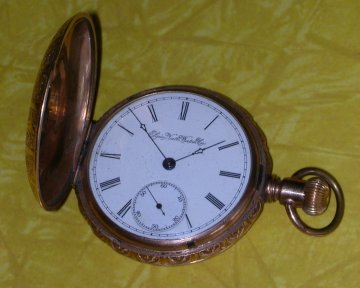
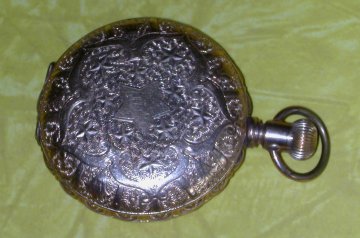
Well, I've been fascinated lately with watches. In fact, fascinated this past year. So when I was over in Wisconsin visiting my folks earlier this week, I was astonished and overjoyed when my dad gave me, for my 50th birthday, the pocket watch which had belonged to my great-great-grandfather.

My Great-Great-Grandpa Roessler had a hotel and tavern in Hustisford, Wisconsin. He also had a stable where he kept some horses. He spoke with a German accent: his parents had come over to this country from Germany. Big mustache, full head of hair even in his nineties. He passed away in 1946, at the age of 96.

elgin natl. watch co.
His pocket watch is still in beautiful condition, and lo and behold, it still runs. My dad said it probably hasn't run in 60 years. I don't intend to run it any more than I can help, until if and when I get it cleaned. The case is decorated on the outside with stars. Inside, the porcelain dial is in very fine condition. The dial reads "Elgin Natl. Watch Co." Very long, thin Roman numerals. Blued steel hands, sunken subseconds dial. The watch measures almost 2¼" across.

I understand from a collectors' site that I could date the watch pretty precisely if I opened it up and read the serial number off the watch movement. Uh uh, not gonna try it on my own. From looking at other Elgin pocketwatches round about on the Internet, I think I'm safe in saying that my great-great-grandfather's watch dates from the late 1800s. I find watches with the same dial and similar case design from 1885, 1890, thereabouts.

At any rate, this pocketwatch is a real piece of family history. My great-great-grandfather no doubt was telling time with it when he turned 50, in 1900, before the Wright Brothers had flown at Kitty Hawk. Amazing to ponder that.

Labels: ,

Thursday, June 22, 2006

Circus 3

circus 3
My brother informs me that Channel 3, in Madison, Wisconsin, is celebrating its 50th anniversary this week. Which means that Channel 3 must have gone on the air within a week of when I was born at Madison General Hospital. (As I got up this morning, I told myself: I'm still in my 40s for two more days yet...)

Actually, if I'd thought, I would've remembered this. Because I remember 25 years ago, back in June of 1981, I was living in an apartment in Madison— as I mentioned the other day, I'd just finished up my master's degree in math at the UW. And I remember at that time Channel 3 celebrating its 25th anniversary by broadcasting a week of old Surfside Six episodes.

When I was a youngster, growing up in a small town north of Madison, one of the big things on Channel 3 was a locally produced show called Circus 3. They had cartoons, they had kids sitting in little bleachers on camera, they had Howie Olson and the famous ventriloquist's dummy, Cowboy Eddie. My brother and I used to watch Circus 3 on TV after school. In fact, for my sixth birthday (this was 1962) I appeared on Circus 3, sitting there in the bleachers. I remember my folks were sort of nervous because, at the last moment, I'd gotten the idea that I was going to look for an opportunity to tell, live on the air, a joke I had made up which I was convinced was the funniest joke of all time:
Q: What did the high step say to the low step?

A: "You're too low to step on!"
Fortunately I somehow never got around to it.

When I was a kid, there were jokes at school about "Cowpie Eddie," and about Cowboy Eddie and termites, or Cowboy Eddie and sawdust. Now my brother tells me that Cowboy Eddie is back in town for Channel 3's 50th anniversary celebration.

Labels:

Thursday, June 08, 2006

Pay No Attention to That World behind the Curtain

Back when I was maybe 8 or 10, I toyed with the idea that the world around me was an illusion, a mere dream. That the real world was completely different, concealed from me by a veil of misperception. I think this is a conceit that many of us have fiddled around with at one time or another. What set my childhood notion apart was that I had quite a vivid image of what the "real" world was like.

In the "real" world, I had been suffering all my life from sleeping sickness, and so for years I had been dreaming our world as I lay there, sound asleep, on my silk-draped catafalque.

Indeed, in the "real" world I was not even human: none of us in the "real" world were remotely human. I lay there, huge, barrel-like body and big round head the size of a large medicine ball. Rough, knotted dark brown hide, with tufts of light brown fur sprouting in odd places. Arms and legs long, thin, and gnarled like tree roots. Eyes like twin radar dishes sunk back into my head. Mouth surrounded by crustacean-like tendrils, opening to reveal a tongue like the trunk of an elephant. Not even remotely human; we were all of us in the "real" world utterly alien creatures of this sort.

And so I was left there to sleep, dreaming of "our" world on my catafalque, amidst pillars and colonnades and porticos of marble all draped with huge fluttering sheets of gauzy dragonfly-wing fabric. Other barrel-like aliens would look in on me now and then, but they knew that my sleeping sickness had no cure, and that I had lain there sleeping for years. And yellow-brown light filtered in, a dusky light that shone down from the catseye-like sun in a striated dull yellow sky overhead. It was hot, like a perpetual summertime. And a buzzing, droning, lulling sound filled the air, a noise like the droning of a herd of distant vacuum cleaners.

This image of a strange and alien "real" world, hidden from me behind a veil of sleep, was tremendously vivid to me when I was in third, fourth, fifth grade. I knew even then (well, 99.8% of the way) that it was a flight of imagination. But it was a fantasy of a kind which I imagine many of us have entertained at one time or another.

Labels: ,

Tuesday, April 18, 2006

Decades

I realize, halfway through this decade, that for the first time in my life, I'm living in a decade without a name. It's rather odd. Not that a decade, considered as a cultural phenomenon, begins or ends odometer-precise with the arrival of a year ending in "0"— or in "1". But there does seem to be a more than just conventional reality to that cultural phenomenon which we conveniently call, for shorthand, a "decade."

(Side note: If there's one species of pedant who deserves to be shot on sight, it's the pedant who wrangles over whether decades begin in a "0" year or a "1" year. Also the pedant who complains that a cultural decade doesn't really coincide exactly with the beginning or ending of a calendar decade. "Wah, wah, wah"— KA-BLAM!!!)

That said, I'd say that what I call the 90s first broke on my consciousness around '93 or '94 or '95: tattoos, body piercing, young adults inexplicably wearing nerdy eyeglasses. Seattle. Coffee. The World Wide Web. TV commercials with half a dozen surreal images per second flashing by. Folks feeling they were really saying something when they tried to justify changing mores by saying, "But it's the Nineties now!" The ongoing bottomless-pit mendacity of the Clintons. A general sense that we were living and eating lotuses at Francis Fukuyama's "End of History." Not all of this broke at once, but over a span of a couple of years I had a definite sense of the culture shifting gears.

And I had a sense that the 90s were culturally far less derivative from the 60s than the 70s or 80s had been.

Speaking of which, for me "the 80s" were pretty much of a piece: say "Reagan" and you're saying "80s." Pretty obvious to me from '81 or so onward. The most peculiar hiccup I noticed in the 80s was the sudden advent, in first few months of 1988, of a neo-moralism which in one guise or another is with us yet. Am I the only person who remembers this? In early January 1988 it was not yet on the horizon. By March or April some commentators were remarking on the sudden shift.

I tend to think of "the 70s" as pretty much mid-to-late 70s. Yeah, yeah, leisure suits, the first primitive electronic video games starting to displace the old mechanical pinball machines: Asteroids, Battlezone. And there was indeed a moment in history (more or less coincident with moon boots) when no self-respecting American male under 40 would've been caught dead in a crewcut. The 70s. Starting some time during Ford's brief presidency, and not outlasting Jimmy Carter's departure from the White House.

As for "the 60s" (actually, the late 60s and early 70s), I remember their advent when I was midway through grade school; and throughout my junior high and high school years, "the 60s" ruled. It was not until the spring of 1975 that it dawned on me that the 60s, as a cultural force, were receding into the past. I was then a college freshman in Madison, Wisconsin, "the Berkeley of the Midwest." Well do I remember reading underground rags like Kaleidoscope and Free for All. Almost until my departure from Madison in 1981, it wasn't hard to look around you and pretend you were still living in the 60s, if only you squinted a little.

And the 50s? I remember the 50s. Which extended actually up through the early 60s. Despite the bad rap which some wild-eyed crazies have given them in retrospect, the 50s were overall a good time. A solid, levelheaded, judicious, sane time. The last sane time we had, and maybe the last sane time we'll ever have. In the 50s, the culture basically just worked. At least from the perspective of the small town American Midwest. A little starchy and repressed, true; it could have taken a little loosening up. What we got when the 60s rolled in was more than just "a little loosening up": Après moi, le déluge.

A cultural "decade" may start or end several years out of synch with a calendar decade. But there does seem to be a real sense of the culture shifting gears, noticeably and within a span of a year or two, every several years. It doesn't go smoothly, it sticks and then slips. If the shift is on the order of magnitude of every 10 years (or 7 or 8 or 12 or 15), we may as well annoy the pedants by referring to it as a "decade."

Oh, and our current nameless decade? I think it's the only one in my lifetime that began abruptly and with a sudden lurch. You probably remember where you were when you heard about it. September 11, 2001.

Labels: , ,

Decades, Part II; Or The Early 1988 Advent of Neo-Moralism, Whassat?!

Wherein I dilate on this point in the preceding post:
The most peculiar hiccup I noticed in the 80s was the sudden advent, in first few months of 1988, of a neo-moralism which in one guise or another is with us yet. Am I the only person who remembers this? In early January 1988 it was not yet on the horizon. By March or April some commentators were remarking on the sudden shift.
The neo-moralism I'm referring to is something that, in my memory, surfaced in a span of just a few months in early 1988.

Again, proceeding purely on the basis of my own memories, it seems that in January of 1988, Nancy Reagan was promoting her "Just Say No" slogan. My own offhand impression at the time (as a conservative who generally supported what the Reagan administration was up to) was that the administration was running out of steam, and this was an attempt to pump the steam pressure back up.

Anyhow, over the next few months, it seems that somehow something about "No" just caught fire in the culture— even among people who detested the Reagans. All of a sudden, even among "sophisticated" people, there was an attitude that it was thinkable to say "No" to excessive drinking, to smoking, to drug use, to randomly sleeping around, to whatever.

I remember reading columns by the likes of George Will and Meg Greenfield, remarking on this sudden sea change in the culture. Really, prior to early 1988, ever since the 60s hit, "sophistos" would have laughed you out of the room for speaking a discouraging word against the wretched excesses of Sex & Drugs & Rock 'n Roll.

And without that shift toward neo-moralism, the later anti-smoking zealotry— to say nothing of today's anti-fast-food thunderhead-on-the-horizon— would have been inconceivable.

Am I making this sudden cultural shift up out of my own mind? I remember browsing in a bookstore in '88 or '89, flipping through some humorous books about the new neo-moralism. I remember how, when John Tower was rejected in '89, people observed that not too long before, it would have been unthinkable to criticize someone seriously for his drinking and partying. My own take at the time was that the generation of the 60s had now aged enough that they could take the attitude of, "Okay, we've had our fun, now don't you dare have yours."

Labels: ,